




Minimalism and Contemporary Classical Music
A New Musical Language Built on Simplicity
Among the many artistic movements that reshaped music during the twentieth century, minimalism stands as one of the most influential and enduring. While earlier generations of composers often embraced complexity, dense orchestration, and elaborate harmonic systems, minimalist composers chose a different direction. They explored how simple musical ideas, repeated and gradually transformed, could create profound emotional and intellectual experiences.
Today, minimalism and contemporary classical music are closely connected. Concert halls around the world regularly present minimalist works alongside traditional repertoire, demonstrating that this once-radical movement has become a respected part of classical music culture.
At ClassicalAurum.com, we view minimalism not as a rejection of tradition but as another chapter in the continuous evolution of classical music. Like every major stylistic revolution, it challenged existing assumptions while opening entirely new artistic possibilities.

The Origins of Musical Minimalism
Minimalism emerged during the 1960s in the United States as a response to the increasing complexity of post-war avant-garde composition. Many composers had become fascinated with serialism, mathematical structures, and highly intellectual systems that often proved difficult for audiences to follow.
Minimalist composers sought another path. Rather than creating music built upon constant change, they focused on steady pulse, repeated patterns, gradual transformation, and harmonic clarity.
Their ideas were influenced by numerous sources, including:
- Eastern philosophy
- Indian classical music
- African rhythmic traditions
- Medieval European music
- Experimental American composition
Instead of dramatic contrasts, minimalist music often unfolds slowly, allowing listeners to become immersed in subtle changes that may initially seem almost imperceptible.
This approach fundamentally changed the relationship between time and musical perception.
The Core Characteristics of Minimalist Music
Minimalism is not defined by the absence of musical material but by the careful organization of relatively simple elements.
Several characteristics appear consistently across minimalist compositions.
Repetition
Short melodic or rhythmic figures repeat continuously. Rather than becoming monotonous, repetition creates familiarity and allows listeners to notice increasingly subtle variations.
Gradual Evolution
Changes occur slowly over time. A single additional note, a slight rhythmic shift, or a harmonic adjustment may completely transform the listener’s perception after several repetitions.
Steady Pulse
Unlike highly flexible Romantic phrasing, minimalist works often maintain a constant rhythmic pulse that creates a hypnotic flow.
Transparent Harmony
Many minimalist compositions rely on consonant harmonies, making them immediately accessible without sacrificing sophistication.
Layering
Different musical patterns overlap, producing rich textures through interaction rather than complexity in individual parts.
The result is music that feels simultaneously predictable and constantly evolving.
The Great Composers Who Defined Minimalism
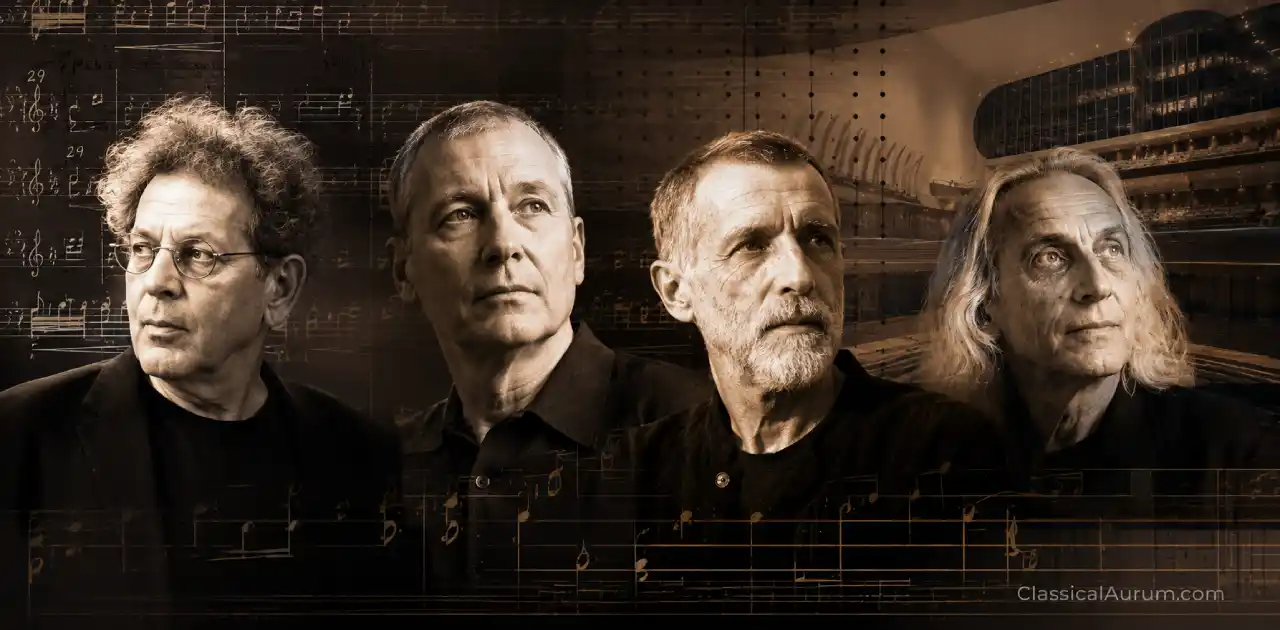
Although many composers contributed to the movement, several figures became internationally recognized as its leading voices.
Philip Glass
Perhaps the best-known minimalist composer, Philip Glass developed a highly recognizable style based on repetitive arpeggios, gradual harmonic changes, and flowing rhythmic structures.
His operas, symphonies, chamber works, and film scores introduced millions of listeners to minimalist aesthetics. Glass demonstrated that minimalist techniques could communicate deep emotion without abandoning structural clarity.
Steve Reich
Steve Reich explored rhythmic processes unlike anything previously heard in Western classical music.
His famous technique of phasing, in which identical patterns gradually move out of synchronization, created constantly changing textures from remarkably simple material.
Works such as Music for 18 Musicians remain landmarks of contemporary classical repertoire.
Terry Riley
Terry Riley’s In C is widely considered one of the foundational works of musical minimalism.
Instead of prescribing every detail, Riley allowed performers flexibility within a structured framework, creating performances that are both disciplined and unique.
La Monte Young
Often regarded as one of minimalism’s earliest pioneers, La Monte Young focused on sustained tones, drones, and long-duration performances that challenged traditional concepts of musical time.
His experimental ideas profoundly influenced later generations.
Minimalism Beyond the Concert Hall
One reason for minimalism’s extraordinary success is its ability to cross artistic boundaries.
Minimalist music has become deeply connected with:
- Film music
- Television soundtracks
- Dance
- Opera
- Contemporary theatre
- Multimedia installations
- Video games
- Meditation and wellness practices
Film composers frequently employ minimalist techniques because repetitive harmonic movement naturally supports visual storytelling without overwhelming dialogue or action.
The influence of minimalism can also be heard in electronic music, ambient music, progressive rock, post-rock, and various experimental genres.
Its vocabulary has become part of the broader musical language of the twenty-first century.
Why Audiences Continue to Embrace Minimalist Music
When minimalism first appeared, some critics dismissed it as overly simple. Others believed repetition could never sustain serious artistic expression.
History has proven otherwise.
Modern audiences often find minimalist music deeply engaging precisely because it encourages focused listening.
Instead of following dramatic narratives, listeners become aware of:
- subtle rhythmic interactions
- changing harmonic colors
- evolving textures
- gradual emotional development
- shifting musical perspectives
Many listeners describe minimalist concerts as immersive experiences rather than conventional performances.
The music invites contemplation while remaining emotionally direct.
In an increasingly fast-paced world, this slower musical unfolding offers a refreshing alternative.
Minimalism’s Influence on Contemporary Classical Composition
Minimalism permanently transformed contemporary composition.
Even composers who do not identify themselves as minimalists frequently incorporate its techniques.
Modern composers often combine minimalist repetition with:
- traditional counterpoint
- orchestral color
- electronic soundscapes
- jazz harmony
- folk influences
- spectral harmony
- cinematic orchestration
This hybrid approach has produced an extraordinary diversity of contemporary classical music.
Today’s composers rarely view minimalism as a strict style. Instead, they treat it as a valuable compositional resource that can coexist with numerous musical traditions.
As a result, contemporary classical music has become more stylistically inclusive than at any previous point in history.
Minimalism in Performance and Interpretation
Performing minimalist music presents challenges very different from those found in Romantic or Classical repertoire.
Musicians must maintain:
- extraordinary rhythmic precision
- unwavering concentration
- perfect ensemble coordination
- consistent tone production
- long-term structural awareness
Even the smallest rhythmic deviation may alter the intended musical process.
Conductors also face unique responsibilities. Rather than emphasizing dramatic tempo changes or expressive rubato, they often focus on maintaining stability while shaping large-scale musical architecture.
Listeners may perceive minimalist music as mechanically repetitive, but successful performances reveal remarkable expressive nuance.
Tiny dynamic shifts, articulation changes, and subtle timing differences can dramatically influence the listener’s experience.
Minimalism and the Digital Age
The digital revolution has further expanded the reach of minimalist music.
Streaming platforms introduce new audiences to contemporary composers every day, while high-quality recordings allow listeners to appreciate works that once circulated only within specialist communities.
Digital technology has also encouraged composers to experiment with algorithmic processes, looping systems, and interactive performance environments that naturally align with minimalist aesthetics.
Artificial intelligence, computer-assisted composition, and real-time electronic processing continue to build upon principles first explored by minimalist pioneers decades ago.
Rather than replacing traditional instruments, technology has expanded the possibilities of minimalist expression.
This evolution demonstrates that minimalism remains remarkably adaptable within modern musical culture.
The Enduring Legacy of Minimalism
Minimalism has evolved from an experimental movement into one of the defining languages of contemporary classical music.
Its influence extends far beyond the works of its founding composers. Today’s orchestras, chamber ensembles, opera companies, universities, and conservatories regularly study and perform minimalist repertoire, recognizing its historical importance and artistic value.
The movement also reminds us that musical innovation does not always require greater complexity. Sometimes, the careful exploration of a few carefully chosen ideas can reveal extraordinary emotional depth.
For listeners, minimalism offers an invitation to slow down and experience music differently. Instead of constantly anticipating dramatic events, audiences learn to appreciate gradual transformation, subtle detail, and the beauty of sustained attention.
At ClassicalAurum.com, we believe that understanding minimalism and contemporary classical music enriches our appreciation of the broader classical tradition. The movement demonstrates that the history of music is not a sequence of isolated styles but a continuous dialogue between tradition and innovation. As new generations of composers continue to reinterpret minimalist principles, its legacy will remain an essential part of the evolving story of classical music, inspiring performers, scholars, and audiences well into the future.

About the Author
Juan Daniel Cabrio
Argentine Classical Guitarist · Researcher · Educator
Juan Daniel Cabrio is an Argentine classical guitarist, researcher and educator. Founder of Classical Aurum, he shares educational and cultural content about classical music, composers, instruments, repertoire, music history and performance practice.
View full biographyExplore more Classical Aurum articles related to this topic.