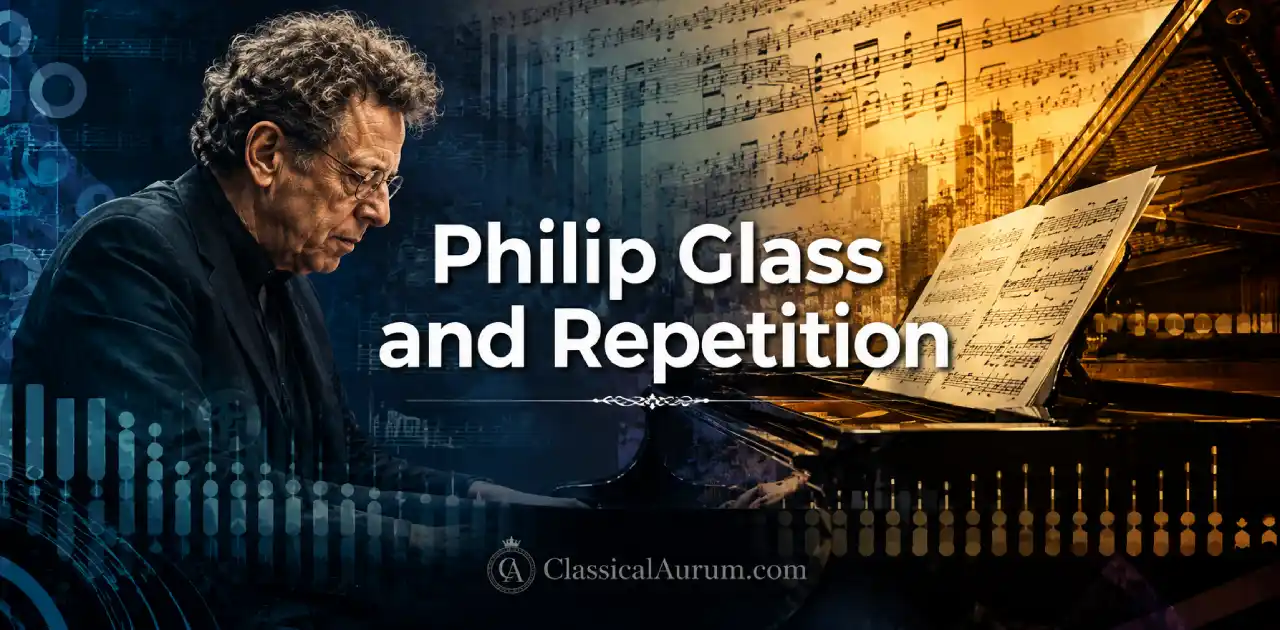
Philip Glass at the Piano

Philip Glass and Repetition
Philip Glass and Repetition
For more than half a century, Philip Glass has challenged traditional ideas about how classical music develops through time. His works often rely on repeating small musical patterns, yet those repetitions rarely remain static. Instead, they evolve gradually, creating soundscapes that seem to expand endlessly while inviting listeners into an entirely different perception of musical time.

Although many people describe Glass simply as a minimalist composer, his artistic language reaches far beyond that label. His music combines repetition with subtle transformation, rhythmic precision, harmonic clarity, and emotional intensity. These characteristics have influenced generations of composers and have reshaped the relationship between classical music and contemporary audiences.

Today, Philip Glass stands as one of the most recognizable composers of the modern era. His operas, symphonies, chamber works, piano music, and film scores demonstrate that repetition can become one of the most expressive tools available to a composer.

Understanding Repetition as a Musical Language

In everyday conversation, repetition often carries a negative meaning. It can suggest monotony or a lack of creativity. In music, however, repetition has served composers for centuries. Folk songs, sacred chants, dance music, and classical forms all rely on recurring musical ideas to create coherence and memory.

Philip Glass transformed this familiar concept into the central engine of musical construction. Instead of treating repetition as decoration, he made it the primary method through which music unfolds.

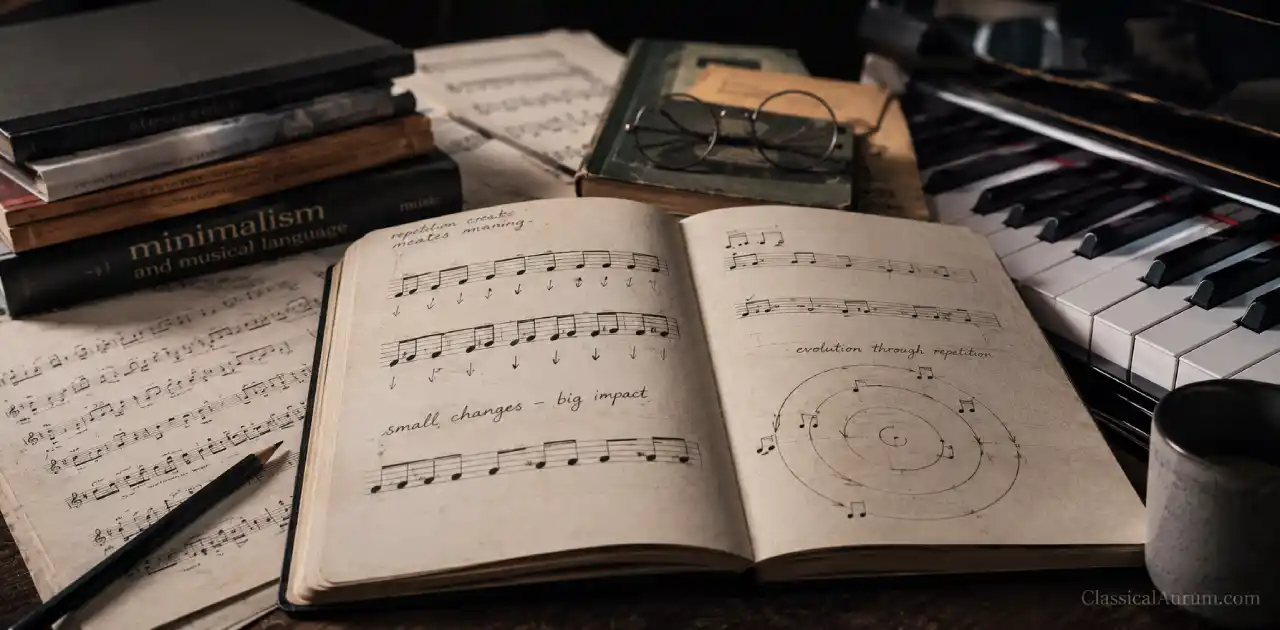
Rather than presenting a melody and moving on, Glass frequently repeats short rhythmic or harmonic figures dozens—or even hundreds—of times. Each repetition introduces tiny modifications that gradually reshape the listener’s experience.

These changes may include:

  • adding one extra note;
  • shifting rhythmic accents;
  • introducing new harmonies;
  • changing instrumental color;
  • layering additional musical voices.

Because the transformations occur slowly, listeners become highly aware of details that might otherwise go unnoticed.

The result is music that feels simultaneously stable and constantly changing. What appears simple on the surface often reveals remarkable structural complexity over time.

Minimalism and the Evolution of Glass’s Style

Philip Glass emerged during the 1960s alongside other American composers who sought alternatives to the complexity of post-war avant-garde music.

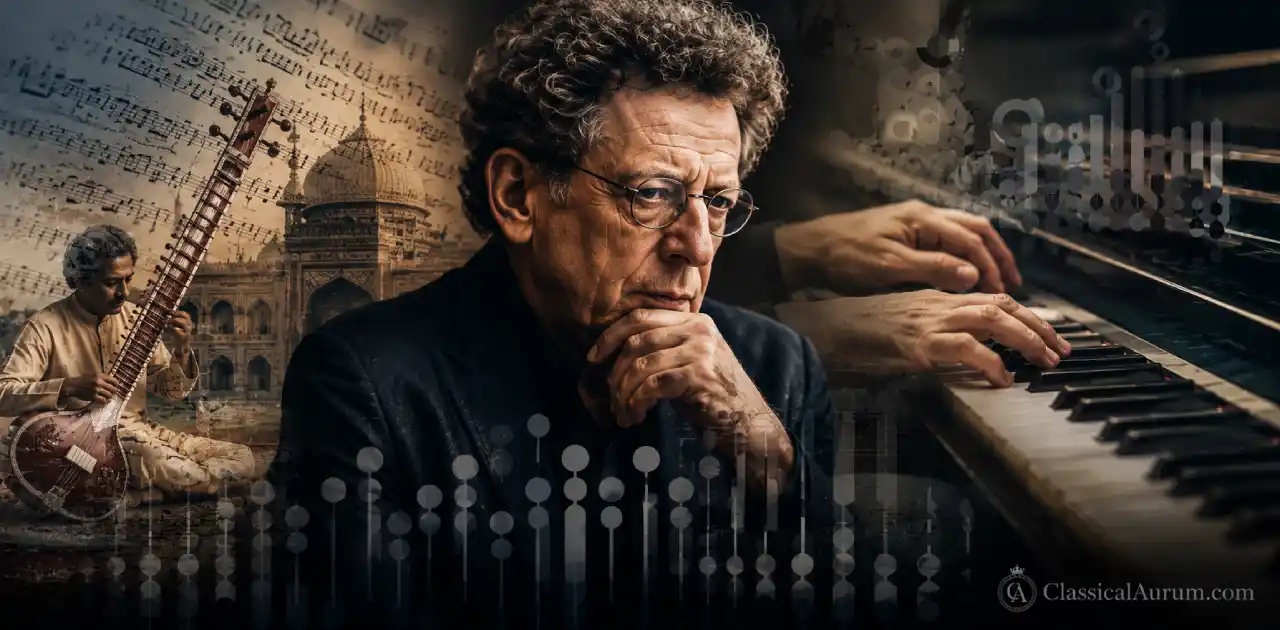
While serialism emphasized intricate mathematical organization, Glass pursued clarity, pulse, and gradual evolution. His early experiences studying in Paris with the legendary composition teacher Nadia Boulanger, combined with his exposure to Indian classical music through his collaboration with sitar virtuoso Ravi Shankar, profoundly influenced his compositional thinking.

From Indian music, Glass learned that musical development did not necessarily depend on dramatic thematic contrasts. Instead, it could arise through gradual expansion, rhythmic cycles, and continuous variation.

These discoveries became foundational to his mature style.

Unlike traditional European symphonic writing, which often depends on conflict and resolution, Glass’s music creates momentum through accumulation.

Small musical cells repeat continuously.

New layers emerge.

Older layers disappear.

Harmonies shift almost imperceptibly.

The listener experiences movement without abrupt transitions.

Although critics initially grouped Glass with minimalist composers such as Steve Reich, La Monte Young, and Terry Riley, his music gradually became more harmonically rich and emotionally expansive.

Over the decades, his style evolved beyond strict minimalism into a highly personal musical language that remains immediately recognizable.

The Psychology of Listening to Repetitive Music

One of the most fascinating aspects of Philip Glass’s music is the way it changes the listener’s perception of time.

Traditional classical compositions often guide audiences through dramatic contrasts, thematic development, and clearly defined climaxes. Glass instead encourages sustained attention.

As repeating patterns continue, listeners gradually stop anticipating sudden musical events. Instead, they begin noticing subtle differences between each cycle.

A tiny harmonic shift suddenly feels significant.

Slight rhythmic displacement creates unexpected tension.

A new instrumental entrance appears almost monumental.

This psychological effect resembles forms of meditation, where repeated actions encourage deeper concentration rather than distraction.

Many listeners report that Glass’s music produces sensations of suspended time. Minutes seem to expand. Musical space becomes immersive rather than directional.

This phenomenon explains why some audiences describe his music as hypnotic while others find it emotionally overwhelming.

Interestingly, the repetition itself is rarely the ultimate goal.

Instead, repetition becomes a framework that allows microscopic musical changes to acquire extraordinary expressive power.

By slowing the pace of transformation, Philip Glass invites audiences to hear music with exceptional focus, discovering beauty in processes that unfold gradually rather than instantaneously.

His approach fundamentally altered expectations about how modern classical music could communicate with listeners, proving that simplicity and sophistication can coexist within the same artistic vision.

Opera and the Expansion of Minimalism

Philip Glass demonstrated that repetition could sustain not only short instrumental works but also large-scale dramatic forms. His breakthrough opera, Einstein on the Beach (1976), redefined expectations of what opera could become in the late twentieth century.

Unlike traditional operas built around linear narratives and conventional arias, this monumental work unfolds through recurring musical structures, visual symbolism, and gradual transformations. The audience experiences the performance as a continuous flow rather than a sequence of isolated scenes.

Glass later expanded his operatic language in works such as Satyagraha, inspired by Mahatma Gandhi, and Akhnaten, portraying the Egyptian pharaoh. Together with Einstein on the Beach, these operas form his celebrated “Portrait Trilogy.”

Although each opera explores a different historical figure, they share a common compositional philosophy. Repetition creates dramatic continuity while slowly evolving harmonies shape emotional progression. Instead of relying on constant plot twists, Glass allows the music itself to generate tension and release.

This approach proved that minimalist techniques could support profound theatrical expression over several hours. Today, these operas remain among the most frequently performed contemporary operatic works, illustrating how repetition can become a powerful storytelling device rather than a compositional limitation.

Film Music and Global Recognition

For many listeners, Philip Glass first became familiar through cinema. His distinctive musical language translated remarkably well to film, where repeated motifs naturally reinforce visual narratives.

His scores avoid overwhelming the images. Instead, they create emotional depth through persistent rhythmic motion and carefully evolving harmonic patterns.

Glass composed acclaimed soundtracks for films such as:

  • Koyaanisqatsi
  • The Hours
  • The Truman Show
  • Candyman
  • Notes on a Scandal

In these films, repetition functions almost like an additional character. Rather than merely accompanying the action, the music shapes the viewer’s emotional perception of time, memory, and atmosphere.

The success of these scores introduced millions of people to contemporary classical music. Many listeners who had never attended a concert hall encountered Glass’s musical language through cinema, documentaries, and television.

His influence soon extended beyond classical audiences. Elements of his style appeared in electronic music, ambient music, post-rock, experimental jazz, and even popular music. Countless composers adopted his methods of gradual development, layered textures, and rhythmic continuity.

By crossing artistic boundaries, Philip Glass demonstrated that modern classical composition could communicate with broad international audiences without sacrificing artistic integrity.

The Lasting Legacy of Repetition

Today, repetition is no longer viewed simply as an experimental technique. Thanks in large part to Philip Glass, it has become one of the defining musical languages of contemporary composition.

His influence can be heard in concert music, film scores, multimedia installations, theater productions, and digital sound design. Composers across the world continue to explore the possibilities of gradual transformation rather than constant contrast.

Perhaps Glass’s greatest achievement lies in changing how people listen.

His music encourages patience instead of immediacy.

It rewards sustained attention rather than rapid consumption.

It reminds audiences that profound emotional experiences often emerge through subtle change rather than dramatic gestures.

This philosophy resonates strongly in today’s fast-moving digital culture, where constant stimulation frequently replaces careful observation.

Exceptional precision

For performers, Glass’s works demand exceptional precision, endurance, and concentration. Every repeated figure must remain rhythmically exact while preserving expressive energy throughout extended performances. Small inaccuracies become immediately noticeable, making his seemingly simple music surprisingly demanding to interpret.

For audiences, the experience can be transformative. What initially appears repetitive gradually reveals extraordinary richness, inviting listeners to appreciate nuance, texture, and the passage of musical time in entirely new ways.

More than five decades after his earliest minimalist experiments, Philip Glass continues to inspire musicians, composers, scholars, and listeners around the globe.

His music demonstrates that innovation does not always require complexity. Sometimes, repeating a single musical idea—with imagination, discipline, and sensitivity—can open entirely new artistic worlds.

The legacy of Philip Glass extends far beyond minimalism itself. He redefined the possibilities of repetition, transformed contemporary classical composition, and expanded the audience for modern concert music across cultures and generations.

For readers of ClassicalAurum.com, his career offers a compelling reminder that classical music is not confined to the past. It continues to evolve through visionary composers who challenge established traditions while creating works of enduring beauty. Philip Glass remains one of those rare artists whose influence reaches beyond style or technique, inviting every listener to experience music as an ever-changing journey where even the smallest variation can reveal something entirely new.

Juan Daniel Cabrio, Argentine classical guitarist, researcher and educator

About the Author

Juan Daniel Cabrio

Argentine Classical Guitarist · Researcher · Educator

Juan Daniel Cabrio is an Argentine classical guitarist, researcher and educator. Founder of Classical Aurum, he shares educational and cultural content about classical music, composers, instruments, repertoire, music history and performance practice.

View full biography