
The Origins of Classical Music
Classical music did not emerge suddenly, nor was it born in a single place or era. It is the result of centuries of cultural refinement, spiritual exploration, intellectual organization, and artistic experimentation. What we call “classical music” today is rooted in ancient ritual, sacred chant, mathematical theory, and the gradual systematization of sound into a written and transmissible art form.
For ClassicalAurum.com, understanding the origins of classical music means tracing the lineage of a living heritage. It means uncovering how sound evolved into structure, how oral tradition became notation, and how sacred expression transformed into an enduring artistic canon. The origins of classical music reveal not only where Western music began, but why it developed the way it did.

Music Before “Classical”: Ancient Foundations
Long before the term “classical” existed, human beings were shaping sound into meaning. In ancient civilizations such as Mesopotamia, Egypt, Greece, and Rome, music was inseparable from religion, poetry, and communal ritual.
In ancient Greece, music was understood as a mathematical and philosophical force. Thinkers such as Pythagoras explored the relationship between numerical ratios and musical intervals. Harmony was not merely aesthetic; it reflected cosmic order. The Greek concept of “ethos” suggested that musical modes could shape character and moral behavior.
Instruments like the lyre and aulos were central to performance, but music remained largely oral. No standardized system of notation existed that would allow music to be preserved with precision.
Rome inherited much from Greece, but it was the early Christian world that transformed musical practice into something more systematized. The shift from pagan ritual to Christian liturgy marked a decisive step in the origins of classical music.
Music began to serve theology.
Gregorian Chant and the Sacred Soundscape
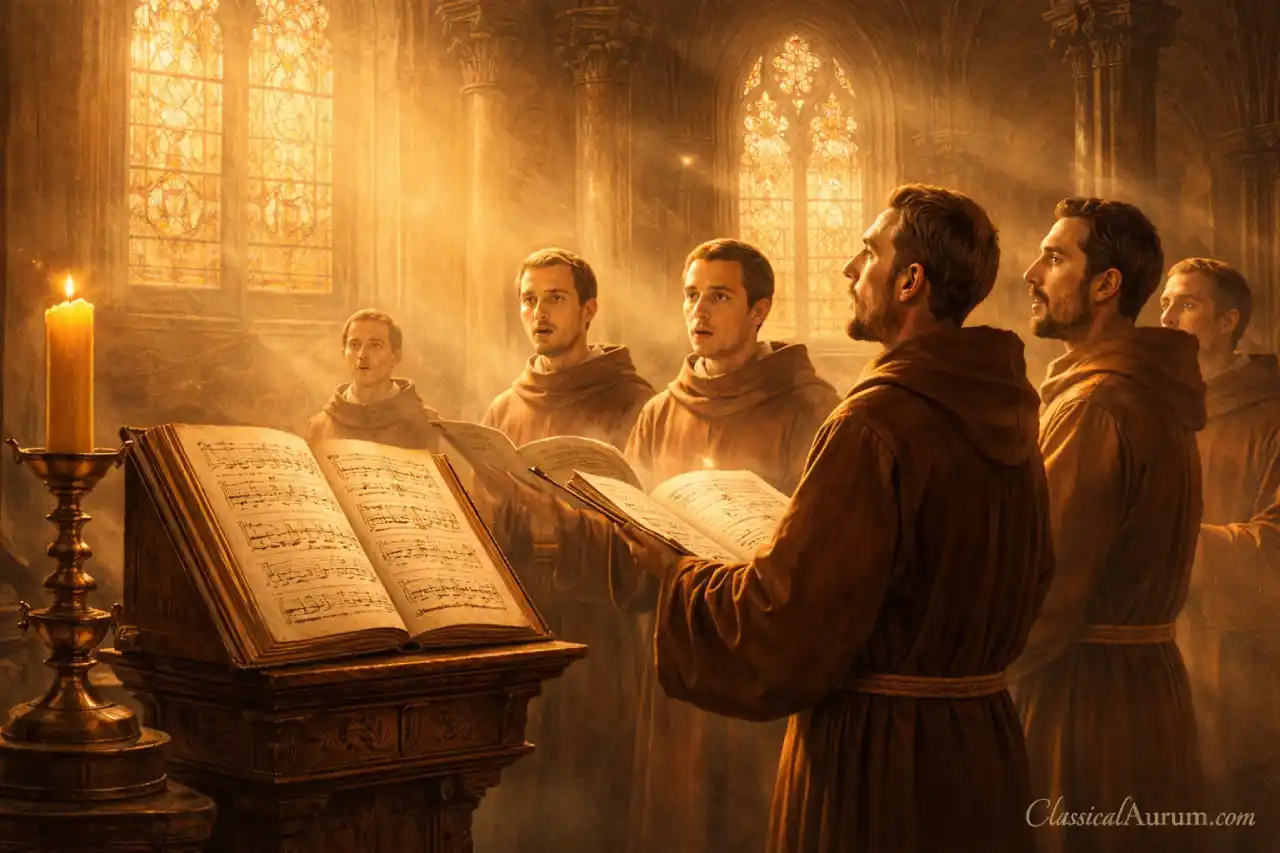
One of the most decisive milestones in the origins of classical music is Gregorian chant. Emerging between the 8th and 9th centuries within the Western Christian Church, this body of sacred monophonic chant became the foundation of Western art music.
Gregorian chant is monophonic, meaning it consists of a single melodic line without harmonic accompaniment. It was sung in Latin and closely aligned with the structure of sacred texts. The rhythm was free, shaped by the natural flow of speech.
Its importance lies not only in its spiritual depth but in its institutional role. The Church standardized chant across Europe, ensuring a shared liturgical repertoire. This standardization required preservation.
Thus emerged early forms of notation.
The need to preserve chant led to the development of neumes—small symbols written above text to indicate melodic contour. Though initially imprecise, neumatic notation was the beginning of musical literacy in the Western tradition.
Without chant, there would be no classical music as we know it.
The Invention of Musical Notation
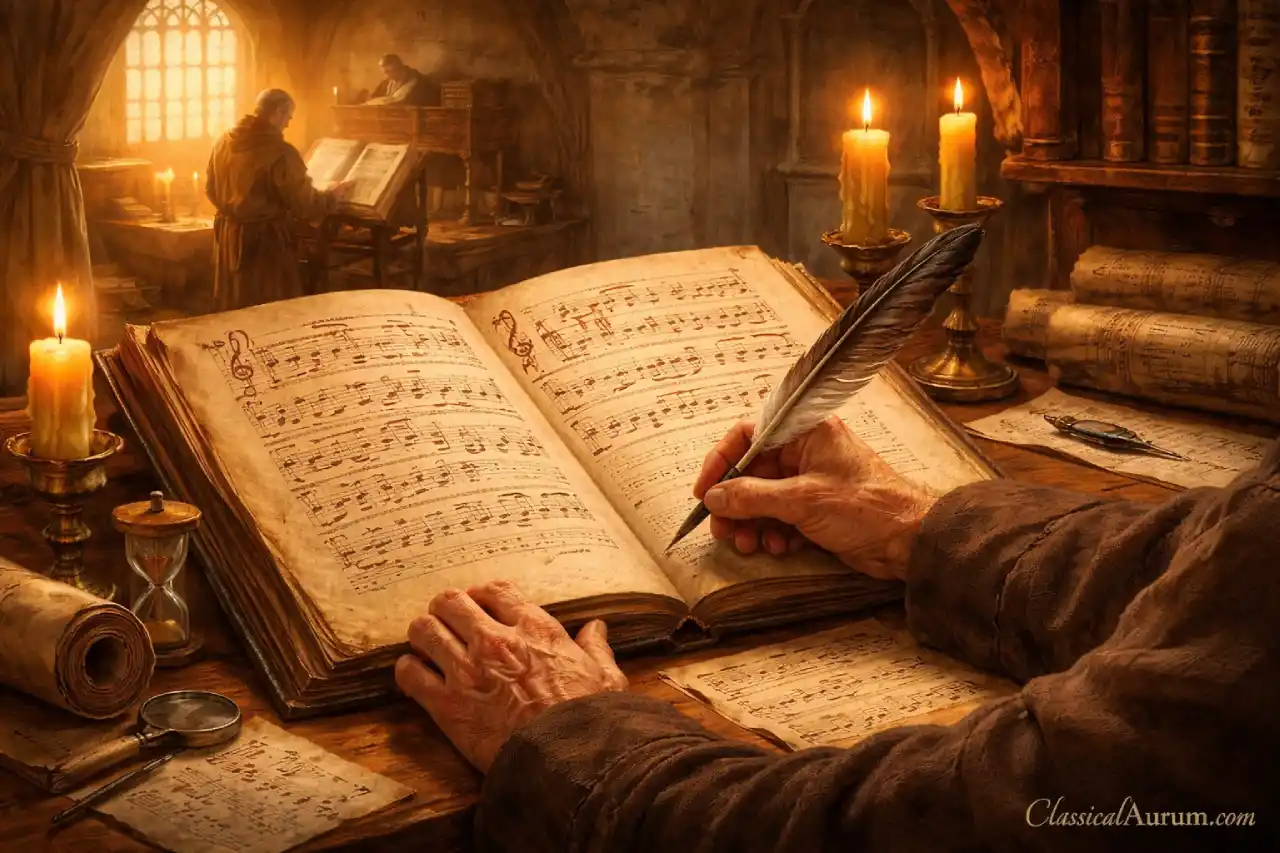
The transition from oral to written tradition marks one of the most revolutionary moments in the origins of classical music. Around the 11th century, the Benedictine monk Guido of Arezzo introduced a more precise system of notation.
Guido developed the four-line staff and solmization syllables (ut, re, mi, fa, sol, la). This innovation allowed singers to learn music more efficiently and ensured greater accuracy in transmission.
Musical notation changed everything.
For the first time, music could be fixed in visual form. It could travel across regions and survive generations without distortion. Composers could begin to think structurally rather than improvisationally.
Notation transformed music from ephemeral performance into architectural art.
At Classical Aurum, we see this as the moment when music begins to resemble the intellectual discipline we associate with classical repertoire today. Structure became possible. Complexity became sustainable.
The written page became a space of creative design.
The Birth of Polyphony
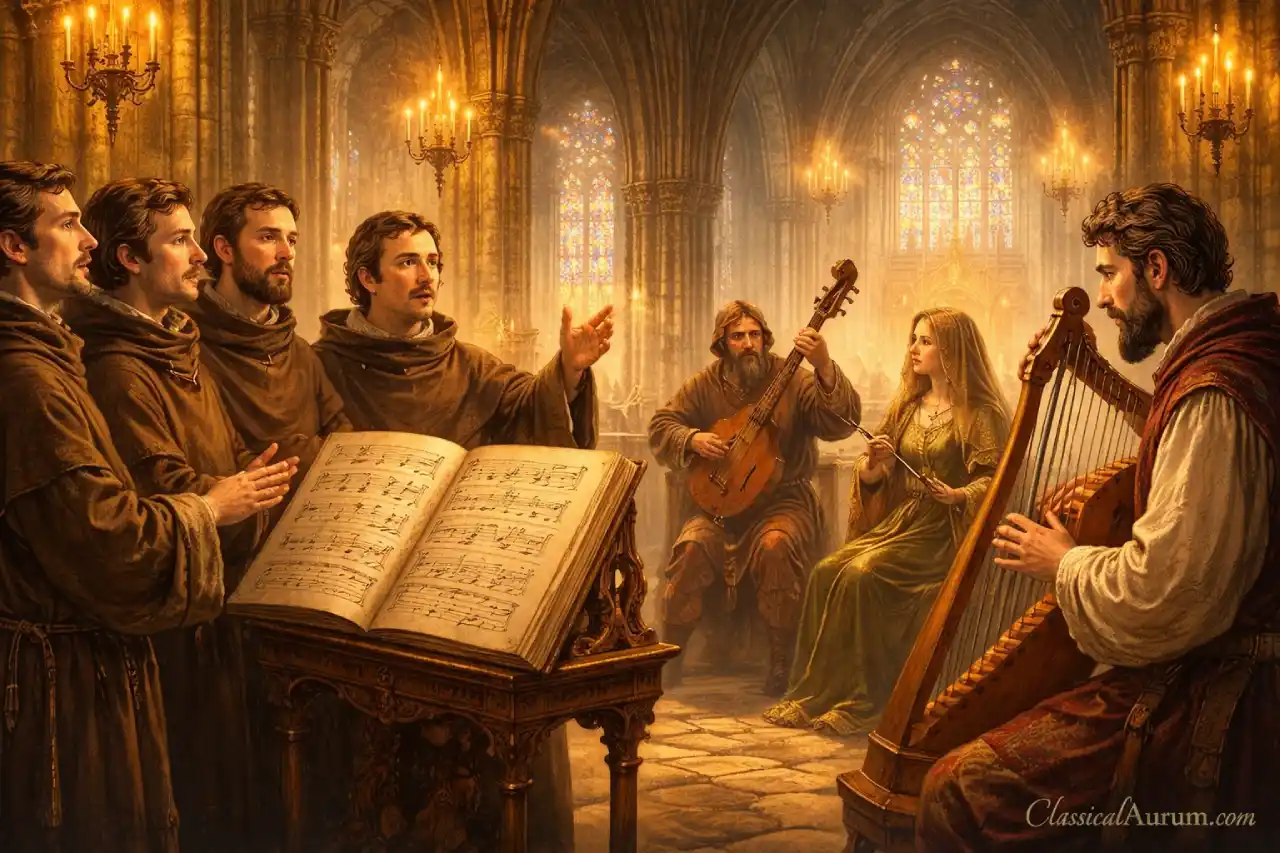
If chant represents unity, polyphony represents expansion. By the 12th century, composers at the Notre Dame school in Paris began experimenting with multiple simultaneous melodic lines.
This was revolutionary.
Instead of a single voice, two or more independent lines moved together. Early polyphony, known as organum, layered a second voice above the original chant melody.
Composers such as Léonin and Pérotin extended this technique, creating elaborate multi-voice works for cathedral performance. These compositions required rhythmic coordination and increasingly sophisticated notation.
Polyphony marks a crucial phase in the origins of classical music because it introduces vertical thinking—harmony.
The concept of harmonic interaction laid the groundwork for all later Western music. Counterpoint, voice leading, and harmonic progression are born from this medieval experimentation.
The cathedral became not only a place of worship but an acoustic laboratory.
The Medieval Sound World Expands
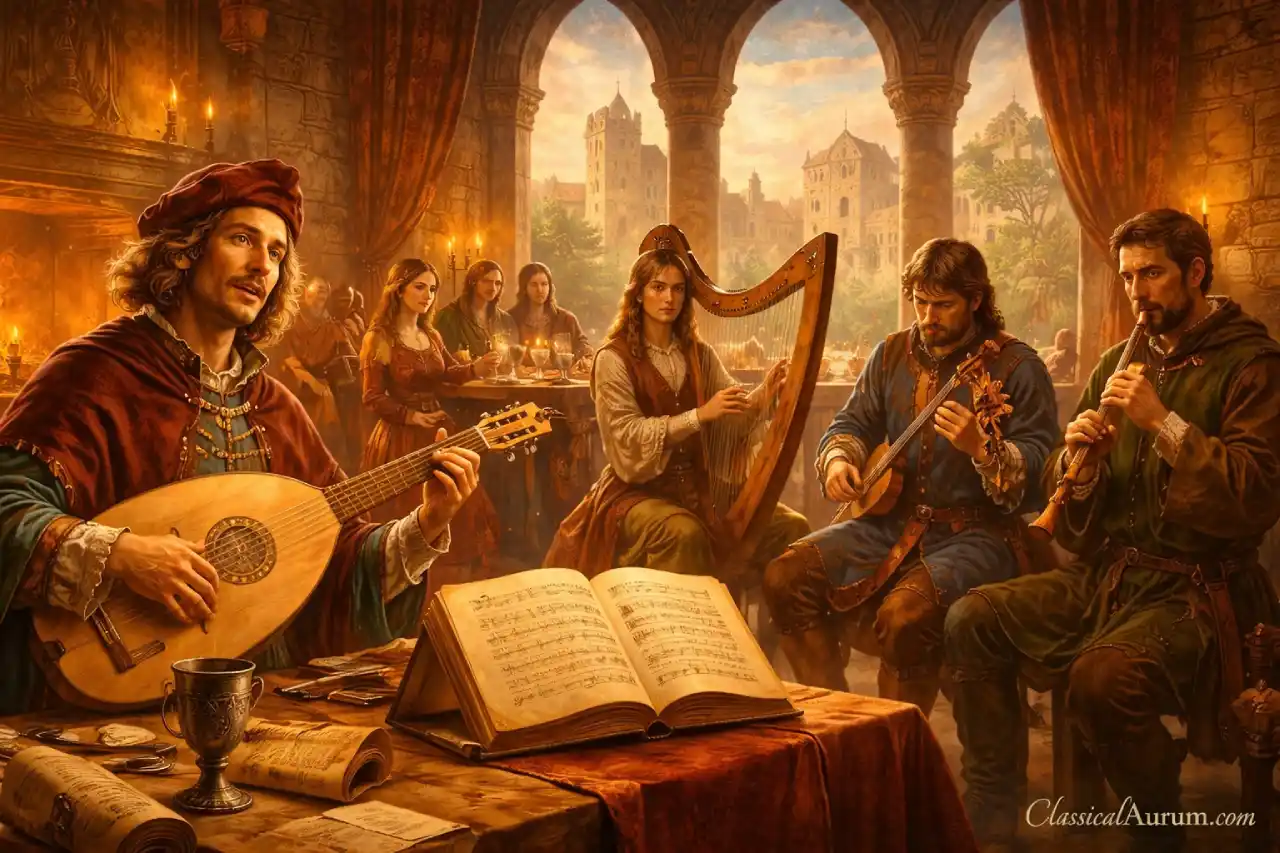
By the late Middle Ages, music had expanded beyond purely liturgical contexts. Secular traditions flourished through troubadours and trouvères in France and minnesingers in Germany.
These poet-musicians composed songs about love, chivalry, and courtly life. Though simpler in structure than sacred polyphony, their work contributed to melodic development and formal clarity.
Meanwhile, rhythmic notation evolved. The introduction of mensural notation allowed composers to specify rhythmic durations more precisely.
This increased precision enabled more complex polyphonic writing.
The medieval period, often misunderstood as musically primitive, was in fact a laboratory of structural invention. Without its experiments in notation, rhythm, and polyphony, the later flowering of Renaissance and Baroque music would not have been possible.
The origins of classical music are deeply medieval.
Renaissance Humanism and Musical Refinement
The Renaissance (15th–16th centuries) brought humanism, balance, and expressive clarity. Music became more refined, smoother in texture, and increasingly responsive to text.
Composers such as Josquin des Prez perfected imitative counterpoint. Voices entered in succession, weaving intricate yet balanced textures.
Sacred forms like the Mass and motet coexisted with secular madrigals.
Printing technology accelerated dissemination. Ottaviano Petrucci’s music printing in 1501 made polyphonic music widely available. Standardization and circulation increased dramatically.
Harmony became more consonant. The modal system gradually moved toward the tonal framework that would define later classical music.
In this era, music shifted from purely institutional function to artistic identity. The composer’s name gained importance.
The Renaissance refined what the Middle Ages invented.
From Modal to Tonal: The Early Baroque Transition
Around 1600, a profound shift occurred. The modal system of medieval and Renaissance music gave way to tonal thinking centered on major and minor scales.
The early Baroque introduced basso continuo, a harmonic foundation played by keyboard or lute with bass instrument. This created vertical harmonic awareness in performance.
Opera was born in Florence as composers sought to revive Greek drama. Claudio Monteverdi bridged Renaissance polyphony with Baroque expressivity.
Music became theatrical.
The tonal system, built on functional harmony, provided the structural backbone for centuries of Western music. This system allowed large-scale forms like sonata, concerto, and symphony to emerge later.
Though the Baroque lies beyond the earliest phase of origins, it completes the foundational arc.
The origins of classical music culminate in tonality.
Sacred, Intellectual, and Architectural
Why did classical music develop differently from other world traditions?
Several forces converged:
-
The institutional power of the Church
-
The invention of precise notation
-
The philosophical legacy of Greek theory
-
The cathedral as acoustic and structural inspiration
-
The gradual codification of harmony
Western classical music evolved as an architectural art. It values structure, proportion, development, and written transmission.
Unlike purely oral traditions, it created a canon—works that could be revisited, analyzed, and performed centuries later.
This continuity is essential to the identity of classical music.
The Living Heritage of Origins
At Classical Aurum, we view the origins of classical music not as distant history but as living foundation.
Every symphony by Beethoven carries echoes of Gregorian chant.
>Every Bach fugue rests on medieval counterpoint.
>Every tonal cadence traces back to modal transformation.
The guitar repertoire itself—central to our editorial identity—emerges from Renaissance and Baroque traditions rooted in these early centuries.
To understand origins is to understand continuity.
The Western classical tradition is not static. It evolves. But it never abandons its structural DNA.
Conclusion: Why Origins Matter
The origins of classical music are a story of transformation:
From ritual to structure.
>From voice to notation.
>From monophony to polyphony.
>From modality to tonality.
It is a story of sacred chant becoming architectural art.
Classical music’s endurance lies in its capacity to preserve its past while expanding into new forms. Its origins explain its depth, discipline, and expressive power.
For ClassicalAurum.com, exploring these origins is foundational to understanding the entire historical arc that follows—from Baroque brilliance to Romantic expansion and modern reinterpretation.
The origins are not the beginning of something finished.
They are the beginning of something still unfolding.