



Medieval Music and the Birth of Western Notation
Before musical notation existed, music lived only in memory. It passed from voice to voice, shaped by tradition rather than documentation. Medieval Europe inherited fragments of ancient Greek theory, early Christian chant, and regional folk practices.
Music was primarily sacred. The Church became the main cultural institution preserving and transmitting sound. In monasteries across Europe, chants structured daily life. These melodies were not yet written in the way we understand today.
Transmission depended on oral repetition. Precision varied between regions. A melody sung in Rome could sound different in Gaul or Iberia. This diversity reflected living tradition, but it also revealed a problem: how to preserve unity across Christendom.
The desire for consistency would eventually give birth to one of the most revolutionary inventions in cultural history: Western musical notation.
Gregorian Chant and the First Written Signs
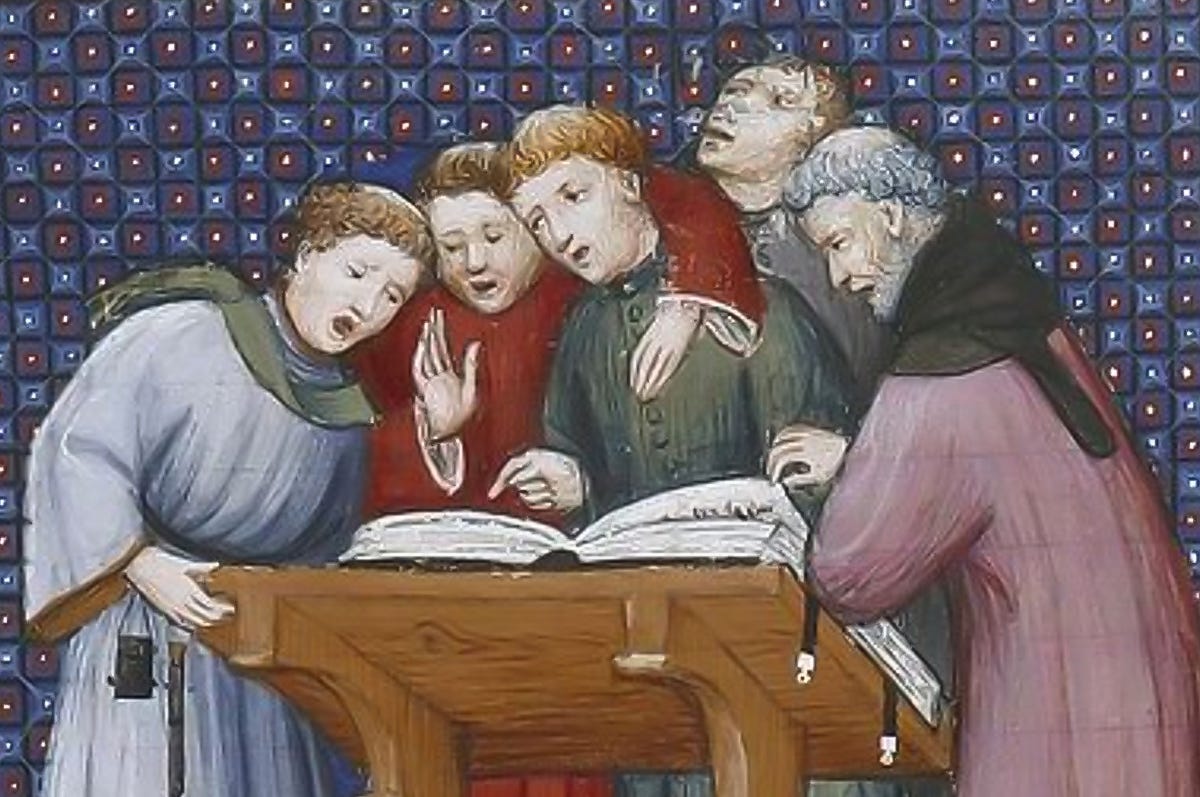
The foundation of medieval sacred music is commonly associated with Pope Gregory I. Although modern scholarship questions his direct authorship, Gregorian chant became symbolically linked to his legacy.
Early attempts to record chant appeared as neumes. These were small graphic marks written above text. They did not indicate exact pitch but suggested melodic contour. They functioned as memory aids rather than precise instructions.
Neumes marked rises and falls in melody. They helped singers recall patterns already learned. This was the first step toward fixing sound on parchment.
Yet these early systems lacked rhythmic and pitch accuracy. The need for greater precision would lead to a breakthrough in the 11th century.
Guido d’Arezzo and the Revolution of the Staff

Guido introduced a four-line staff. Instead of approximate melodic shapes, pitches could now be placed at exact vertical positions. This system allowed singers to read unfamiliar music without hearing it first.
He also developed solmization syllables: ut–re–mi–fa–sol–la. These syllables formed the basis of modern solfège. They emerged from a hymn to St. John, where each line began on progressively higher pitches.
Another pedagogical tool was the Guidonian Hand. Singers memorized pitch relationships by associating notes with points on the hand. This method democratized musical training.
With Guido’s work, music was no longer dependent solely on memory. It became teachable, transferable, and expandable.
The Rise of Polyphony and the Notre Dame School

As notation improved, composers began experimenting with multiple simultaneous voices. This practice, known as polyphony, marked a radical departure from monophonic chant.
The most influential center of early polyphony was the Notre Dame Cathedral in Paris. The Notre Dame School became synonymous with innovation.
Composers such as Léonin and Pérotin expanded organum into complex multi-voice structures. Rhythmic modes began to emerge.
Notation evolved again to accommodate rhythm. Modal notation introduced patterns of long and short durations. For the first time, composers could shape temporal architecture on the page.
The written system enabled complexity. Without notation, polyphony at this scale would have been impossible.
Music, Theology, and Intellectual Culture
Medieval music was not merely artistic expression. It was deeply theological and philosophical.
Drawing on ancient authorities like Boethius, medieval thinkers classified music as part of the quadrivium alongside arithmetic, geometry, and astronomy. Music reflected cosmic order.
Sound symbolized divine harmony. Proportions in chant and polyphony mirrored theological ideas about unity and multiplicity.
The ability to write music strengthened its intellectual legitimacy. It elevated composition from ephemeral practice to scholarly discipline.
By the late Middle Ages, theoretical treatises circulated widely. Notation standardized knowledge. A pan-European musical language began to form.
From Monastery to Manuscript Culture

As universities emerged in cities such as Paris and Bologna, intellectual exchange intensified. Music theory developed alongside scholastic philosophy.
By the 14th century, notation grew even more sophisticated. The Ars Nova introduced refined rhythmic systems. Composers could notate syncopation and complex meters.
The medieval period ended with a fully developed notational framework. Renaissance masters inherited a stable written language of sound.
Why Medieval Notation Still Matters Today
Modern classical music rests upon medieval foundations. Every staff, clef, and notehead traces its lineage to innovations of the 11th and 12th centuries.
Without notation, there would be no symphonies, no operas, no chamber works. Written music made large-scale composition possible.
For performers and scholars today, medieval manuscripts reveal the origins of Western musical literacy. They show how sound became architecture.
At ClassicalAurum.com, understanding medieval notation is not antiquarian curiosity. It is the beginning of a lineage that continues through Bach, Mozart, and beyond.
The medieval world transformed music from memory into manuscript. That transformation changed civilization itself.
Explore more Classical Aurum articles related to this topic.