
Gregorian Chant Explained
The mysterious origins of Gregorian chant
Few musical traditions have influenced the history of Western civilization as profoundly as Gregorian chant. Its solemn melodies, flowing vocal lines and spiritual atmosphere continue to fascinate musicians, historians and listeners centuries after their creation. Even today, Gregorian chant remains associated with silence, contemplation and sacred beauty.
Gregorian chant emerged during the early Middle Ages within the liturgical traditions of the Western Christian Church. Although many people associate it directly with Pope Gregory I, historians believe the development of chant was far more gradual and complex. The name “Gregorian” became attached to the tradition centuries later, helping reinforce the authority of the Roman liturgy across Europe.
The musical roots of chant stretch back to ancient sacred practices. Jewish synagogue singing, early Christian psalmody and Roman liturgical traditions all contributed to the formation of this unique style. Over time, monasteries became the principal guardians of chant, preserving and transmitting the repertoire through oral tradition before musical notation became widespread.
Unifying religious ceremonies
One reason Gregorian chant became so influential was its role in unifying religious ceremonies across medieval Europe. As the Roman Church expanded its authority, it promoted a standardized musical language for worship. Chant allowed monasteries and churches from distant regions to share a common spiritual identity through sound.
Related: From Sacred Chant to Secular Sound
Unlike modern music focused on rhythm or harmony, Gregorian chant centers on a single melodic line. This monophonic structure creates an atmosphere of purity and introspection. Without instrumental accompaniment, the human voice becomes the sole vehicle for sacred expression.
For listeners today, Gregorian chant often feels timeless. The absence of strong rhythmic patterns and the smooth movement of melodies create a floating sensation that transcends ordinary musical expectations. This quality is one reason the tradition continues to inspire composers, filmmakers and spiritual communities worldwide.
Related: Medieval Music and the Birth of Western Notation
The acoustics of medieval cathedrals also shaped the sound of chant. Massive stone walls and reverberant spaces amplified vocal resonance, transforming simple melodies into immersive sonic experiences. In many ways, Gregorian chant was designed not only for prayer but also for architecture itself.
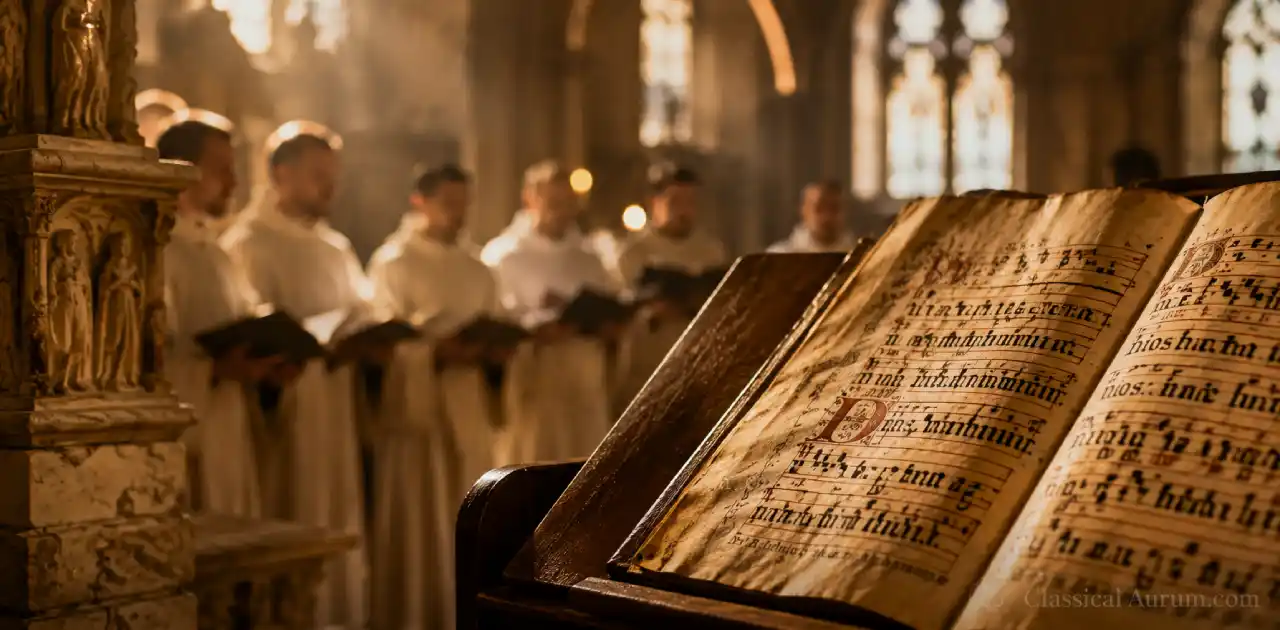
How Gregorian chant works musically
Understanding Gregorian chant requires entering a musical world very different from modern classical music. The system behind chant developed before the widespread use of harmony, orchestration and complex rhythmic notation.
One of the defining characteristics of Gregorian chant is its use of modal scales rather than modern major and minor tonalities. Medieval theorists organized chants into eight primary modes, each with its own emotional color and melodic behavior. These modes helped shape the spiritual mood of liturgical ceremonies.
Rather than emphasizing dramatic contrast, chant melodies usually move step by step in smooth contours. Large melodic leaps are relatively rare. This flowing quality reinforces the meditative atmosphere associated with sacred worship.
Rhythm in Gregorian chant is also distinctive. Unlike modern compositions governed by strict meter, chant follows the natural rhythm of Latin text. Phrasing emerges organically from the pronunciation and accentuation of words rather than from repetitive beats.
The liturgical language
The language itself plays a central role. Most Gregorian chant is sung in Latin, the liturgical language of the medieval Western Church. Because the music serves the text, the clarity of sacred words remains essential.
Another important element is the absence of instrumental accompaniment. Gregorian chant is traditionally performed a cappella, allowing voices to blend into a unified sound. This simplicity contributes to the sense of spiritual purity often associated with the tradition.
Early chant notation differed dramatically from modern sheet music. Medieval scribes used symbols called neumes, which indicated melodic movement rather than exact pitches or durations. Over time, these systems evolved into more precise notation, eventually laying the foundation for modern Western musical writing.
The development of musical notation through Gregorian chant represents one of the most important moments in music history. Without these innovations, the preservation of complex compositions across generations would have been far more difficult.
Many musicologists consider Gregorian chant the starting point of Western art music. Polyphony, counterpoint and later classical traditions all emerged from the foundations established by medieval sacred music.
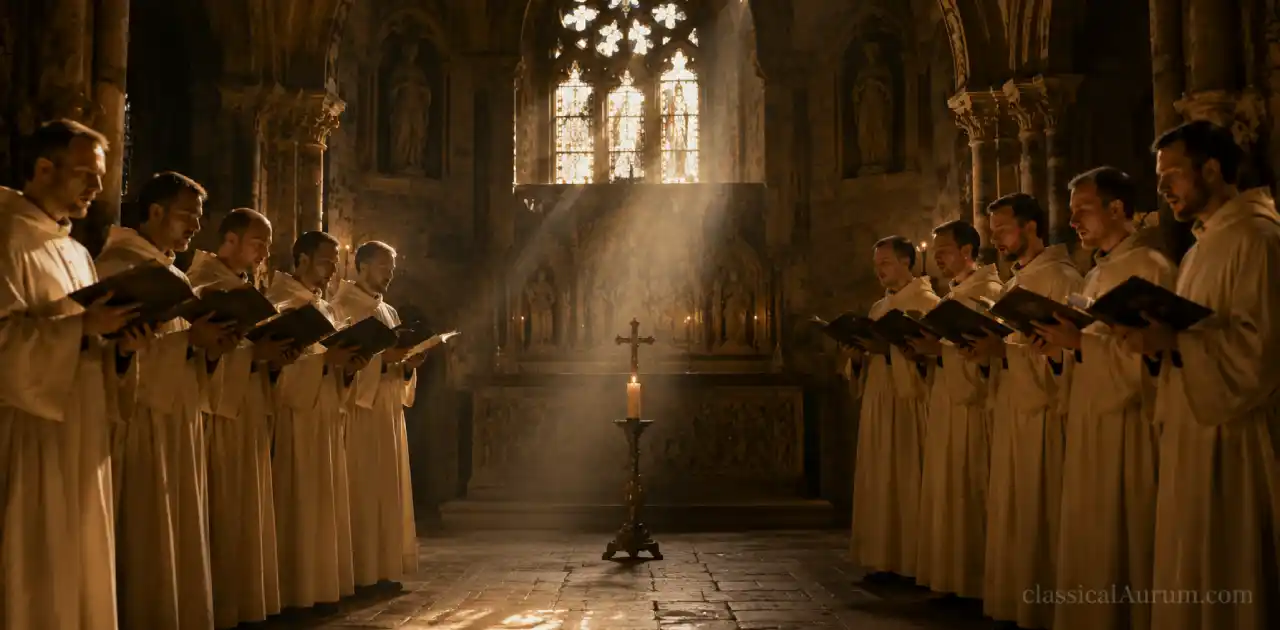
The spiritual and cultural importance of Gregorian chant
Gregorian chant was never intended merely as entertainment. Its primary purpose was spiritual. The music functioned as a form of prayer, meditation and theological expression within religious ceremonies.
In medieval monasteries, monks structured daily life around cycles of prayer known as the Divine Office. Chant accompanied these rituals throughout the day and night. Singing became part of a disciplined spiritual routine connecting music with contemplation.
The emotional effect of Gregorian chant often comes from restraint rather than dramatic intensity. Its calm melodic movement encourages inward reflection. This contemplative quality explains why many modern listeners use Gregorian chant for meditation, concentration or relaxation.
Throughout history, sacred music has reflected broader cultural transformations. Gregorian chant helped preserve intellectual and artistic continuity during periods of political instability in medieval Europe. Monasteries became centers not only of spirituality but also of education, manuscript preservation and musical transmission.
Experiments built upon chant melodies
The influence of chant extended far beyond religion. Medieval universities, early composers and Renaissance musicians all inherited aspects of its musical language. Even the evolution of harmony can be traced back to experiments built upon chant melodies.
The connection between chant and architecture is equally significant. Gothic cathedrals amplified the resonance of voices, creating a mystical sonic environment. The acoustical interaction between space and sound became part of the spiritual experience itself.
In the modern era, Gregorian chant experienced several revivals. During the nineteenth century, scholars and monks sought to restore authentic medieval performance practices. Research centers such as the Abbey of Solesmes in France played a major role in preserving and studying chant traditions.
Unexpectedly, Gregorian chant also entered popular culture during the late twentieth century. Chant recordings achieved commercial success, introducing sacred medieval music to entirely new audiences. Films, documentaries and ambient music producers began incorporating chant textures into contemporary media.
Despite technological change and shifting cultural values, Gregorian chant continues to symbolize silence, transcendence and spiritual depth. Its ability to evoke timelessness remains one of its most powerful qualities.
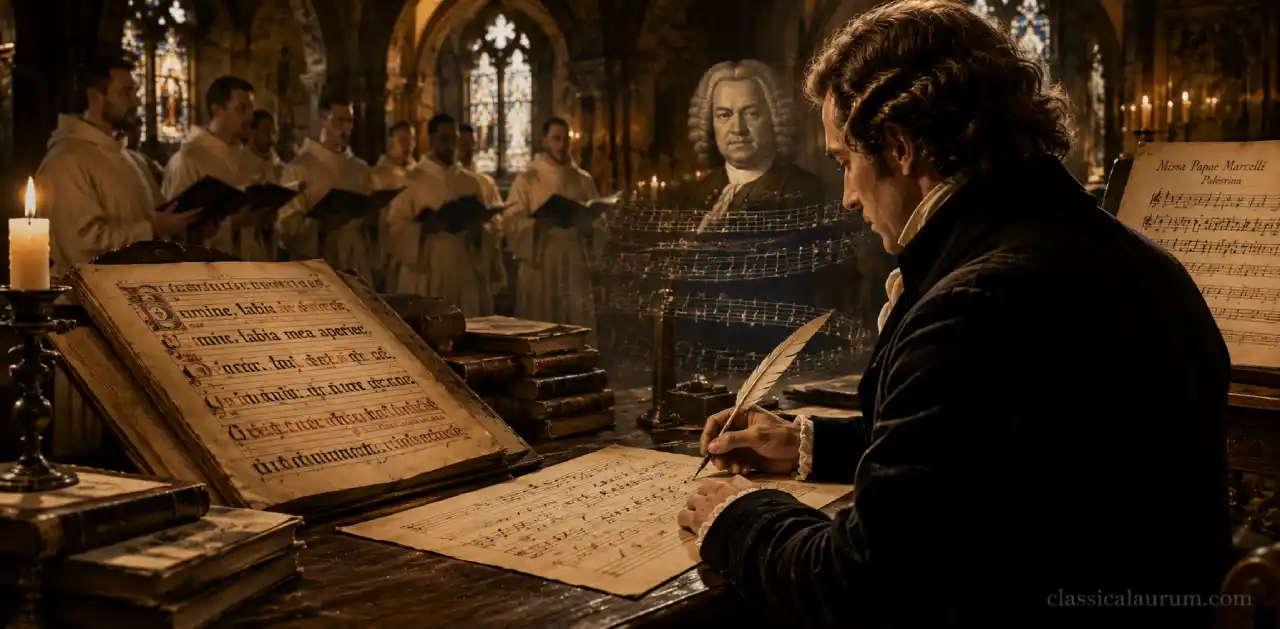
Gregorian chant and its influence on classical music
The history of classical music cannot be fully understood without Gregorian chant. Many techniques associated with later Western composition originated directly from medieval sacred traditions.
One major development was the emergence of polyphony. Early composers began adding additional melodic lines above existing chant melodies. This experimentation eventually led to the sophisticated vocal textures of Renaissance sacred music.
Composers such as Léonin and Pérotin expanded chant traditions within the Notre Dame school of medieval composition. Their innovations transformed simple monophonic melodies into elaborate musical structures that shaped the future of European music.
Gregorian chant also influenced the development of counterpoint. The careful interaction between independent melodic lines became central to Western composition for centuries. Without chant as a foundation, the works of later masters such as Palestrina, Bach and Mozart might have evolved very differently.
Even after the rise of opera and orchestral music, chant continued to inspire composers. Renaissance masses frequently incorporated Gregorian melodies as structural material. During the Romantic era, composers rediscovered medieval sacred traditions as sources of spiritual depth and historical identity.
Twentieth-century composers also explored chant influences. Maurice Duruflé, Olivier Messiaen and Arvo Pärt integrated chant-inspired textures into modern sacred compositions. Their music demonstrates how ancient melodic traditions can coexist with contemporary harmonic language.
Inspiration from Gregorian chant
Film music has likewise drawn inspiration from Gregorian chant. Epic historical films, fantasy productions and psychological thrillers often use chant-like sonorities to evoke mystery, spirituality or ancient ritual.
The minimalist movement in modern music shares surprising similarities with chant aesthetics. Repetition, slow development and meditative atmosphere connect contemporary minimalism with medieval sacred traditions.
Beyond composition, Gregorian chant shaped vocal technique itself. The emphasis on blended resonance, smooth phrasing and textual clarity influenced centuries of choral singing practices.
Today, many conservatories and early music ensembles continue studying Gregorian chant not only for historical reasons but also for its artistic value. Performers increasingly seek historically informed interpretations that recreate the acoustical and spiritual atmosphere of medieval liturgical spaces.
Why Gregorian chant still fascinates modern audiences
In an era dominated by digital stimulation and constant noise, Gregorian chant offers something increasingly rare: stillness. Its enduring appeal may come precisely from its contrast with modern culture.
Listeners often describe Gregorian chant as calming or transcendent. Scientific studies exploring music and the brain suggest that slow vocal textures can influence emotional states, breathing patterns and concentration. This may explain why chant is frequently used in meditation and wellness contexts.
The simplicity of Gregorian chant also feels refreshing in a world saturated with complex production and rapid musical editing. A single human voice singing ancient melodies can create emotional depth without technological enhancement.
Modern audiences are also drawn to the historical mystery surrounding medieval music. Gregorian chant evokes images of monasteries, illuminated manuscripts and candlelit cathedrals. This atmosphere connects listeners with a distant cultural memory.
Streaming platforms and digital archives have made chant more accessible than ever. Recordings by monastic communities and early music ensembles allow global audiences to experience sacred traditions once confined to religious institutions.
At the same time, scholarly research continues uncovering new insights into medieval performance practices. Historians analyze manuscripts, acoustics and liturgical traditions to better understand how chant originally sounded.
Contemporary sacred music communities
Gregorian chant also holds significance for contemporary sacred music communities. Many churches continue using chant within liturgical services, preserving a living connection to centuries of tradition.
For musicians, chant remains a powerful educational tool. Studying its melodic structure, phrasing and modal language can deepen understanding of Western musical history.
Perhaps the greatest strength of Gregorian chant lies in its universality. Even listeners without religious backgrounds often respond emotionally to its atmosphere of serenity and introspection. The music communicates through resonance and space rather than dramatic spectacle.
As modern culture becomes increasingly fragmented, Gregorian chant continues offering a rare sense of continuity with the past. It reminds listeners that music can serve not only entertainment but also reflection, spirituality and human connection.
The survival of Gregorian chant across more than a millennium demonstrates the extraordinary power of simplicity. Its melodies continue echoing through churches, concert halls and recordings, preserving one of humanity’s oldest and most influential musical traditions.