
Sacred Music in Western Tradition
The Origins of Sacred Music in Europe
The history of sacred music in Western tradition is inseparable from the development of European civilization itself. Long before concert halls, opera houses, or symphonic institutions existed, music lived primarily inside churches, monasteries, and religious ceremonies. Sacred sound shaped the emotional and spiritual imagination of the Western world for centuries.
In the early Middle Ages, Christian liturgy became one of the principal forces behind musical organization. Monastic communities preserved and transmitted musical knowledge through oral tradition before notation systems were fully standardized. The desire to unify worship across expanding territories encouraged the creation of common liturgical chants.
Among the earliest and most influential forms was Gregorian chant, named after Pope Gregory I, although its origins are more complex and collective than legend suggests. Gregorian chant established many foundations of Western musical language: modal systems, melodic contour, sacred phrasing, and disciplined vocal expression.
Unlike later harmonic music, Gregorian chant was monophonic. A single melodic line flowed freely without instrumental accompaniment. This simplicity created an atmosphere of contemplation that transformed cathedral acoustics into part of the musical experience itself.
The architecture of medieval cathedrals deeply influenced sacred music. Stone walls and enormous reverberant spaces encouraged slower melodic movement and sustained vocal resonance. Sacred music was therefore not only composed for worship but also shaped by physical environments designed to inspire awe.
According to the official resources of the Vatican Museums, liturgical art and music evolved together as expressions of spiritual transcendence inside Christian civilization.
Sacred music became more than ritual accompaniment. It emerged as a cultural system capable of preserving memory, theology, artistic identity, and emotional depth across generations.
Gregorian Chant and the Birth of Musical Notation
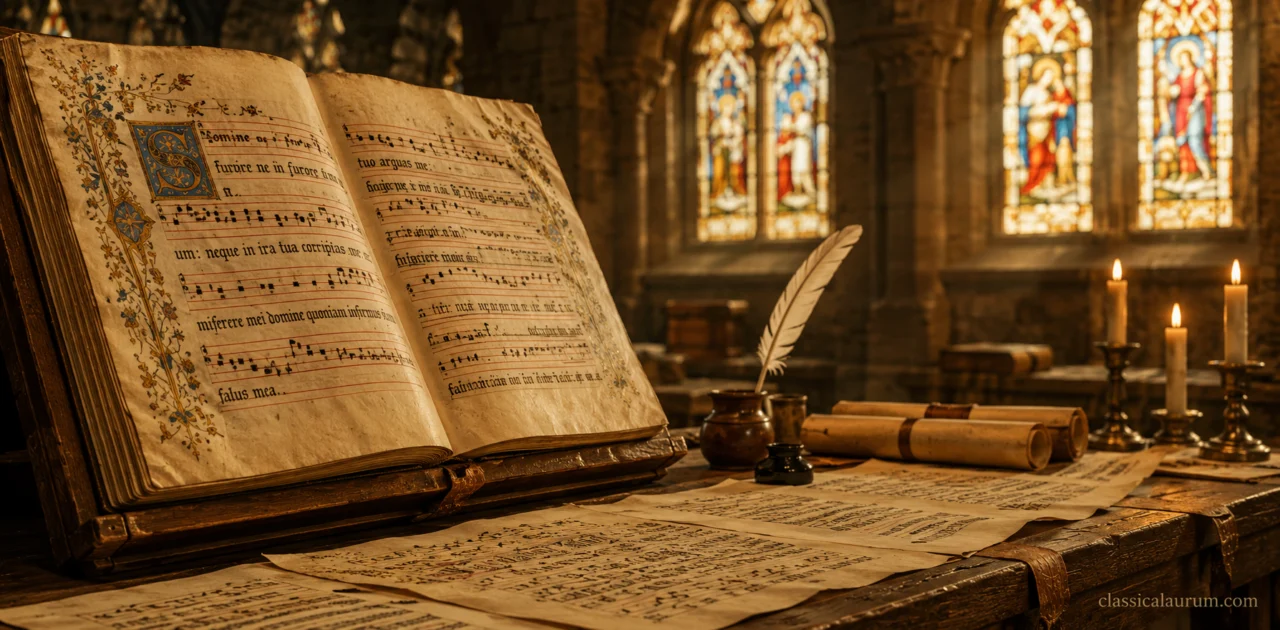
One of the greatest achievements of sacred music was the creation of systems capable of preserving sound across centuries. Before notation, music depended entirely on memory. The development of musical writing changed Western history forever.
Early notation appeared through symbols called neumes, which indicated melodic direction rather than exact pitches. Over time, these systems became more precise. The innovations associated with Guido d’Arezzo in the 11th century revolutionized musical learning and transmission.
The staff notation system allowed sacred music to spread consistently throughout Europe. Choirs separated by vast distances could perform the same liturgical works with remarkable accuracy. This represented a turning point not only for religion but for all future classical music.
Gregorian chant also established an educational structure for musicianship. Choir schools connected to cathedrals trained singers in discipline, reading, breathing, and collective interpretation. Many future composers emerged from ecclesiastical musical environments.
The modal system used in chant influenced medieval and Renaissance composition profoundly. Even centuries later, echoes of Gregorian modality can be heard in works by composers such as Claude Debussy and Olivier Messiaen.
Sacred music also encouraged the development of acoustical awareness. Composers learned how melodies interacted with architectural space. Long reverberations demanded clarity, vocal purity, and careful pacing.
The importance of chant survives today not merely as historical curiosity but as living tradition. Institutions like The Abbey of Solesmes continue researching and performing Gregorian chant using historically informed methods.
For many listeners, Gregorian chant represents one of the purest forms of sacred contemplation in music history. Its restrained beauty contrasts sharply with the speed and noise of contemporary life.
Renaissance Polyphony and the Golden Age of Sacred Choral Music
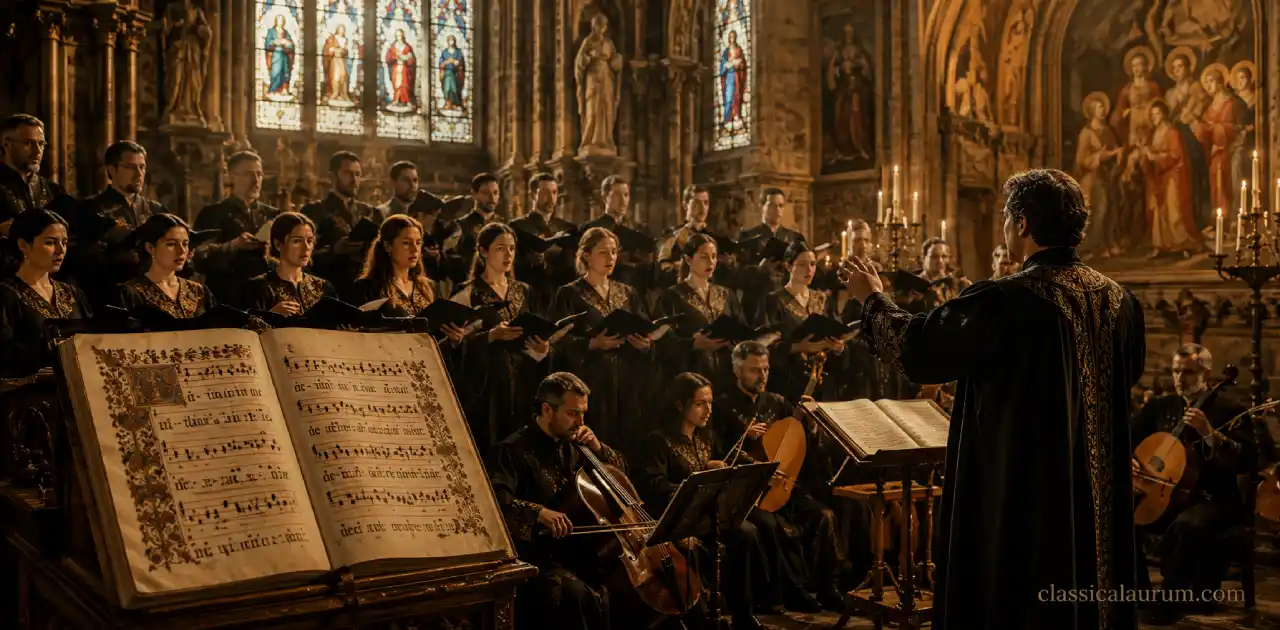
During the Renaissance, sacred music underwent a dramatic transformation. Composers began exploring polyphony, the art of combining multiple independent vocal lines simultaneously. This innovation created extraordinary complexity and emotional richness.
Renaissance sacred music reflected broader intellectual and artistic developments occurring throughout Europe. Humanism encouraged deeper exploration of beauty, proportion, and expressive possibility. Sacred composition became increasingly sophisticated without abandoning spiritual purpose.
Composers such as Giovanni Pierluigi da Palestrina, Tomás Luis de Victoria, and Orlando di Lasso elevated sacred choral writing to extraordinary artistic heights.
Palestrina became especially important during the Counter-Reformation. According to longstanding tradition, his music demonstrated that polyphony could remain spiritually intelligible despite increasing complexity. His balanced textures and flowing vocal lines became models of sacred clarity.
The Renaissance Mass reached remarkable levels of structural unity. Composers developed techniques such as imitation, cantus firmus treatment, and controlled dissonance to produce music of immense refinement.
Sacred motets flourished during this period as well. Unlike the Mass, motets allowed greater flexibility in text and structure. Many became emotionally powerful meditations on biblical themes.
The relationship between sacred music and architecture intensified further during the Renaissance. Polyphonic choirs interacting with cathedral acoustics created immersive sonic experiences unlike anything heard before.
The influence of Renaissance sacred music remains enormous today. Choirs across the world continue performing these masterpieces because they combine technical brilliance with spiritual depth.
Organizations like The Tallis Scholars helped revive global appreciation for Renaissance sacred polyphony through historically informed performance.
For ClassicalAurum.com, this repertoire represents a central pillar of Western musical civilization: disciplined, transcendent, intellectual, and profoundly human.
Baroque Sacred Music and the Spiritual Drama of Sound
The Baroque era introduced dramatic emotional intensity into sacred music. Composers embraced contrast, ornamentation, instrumental color, and theatrical expression while continuing to serve liturgical and spiritual functions.
Perhaps no composer symbolizes sacred Baroque music more powerfully than Johann Sebastian Bach. His sacred works represent one of the greatest artistic achievements in Western history.
Bach composed cantatas, passions, motets, chorales, and monumental liturgical works that fused theology with extraordinary musical architecture. Pieces such as the Mass in B Minor and the St Matthew Passion transformed sacred storytelling into overwhelming emotional experiences.
In Bach’s music, sacred structure and human emotion coexist seamlessly. Counterpoint becomes spiritual architecture. Harmony becomes theological reflection.
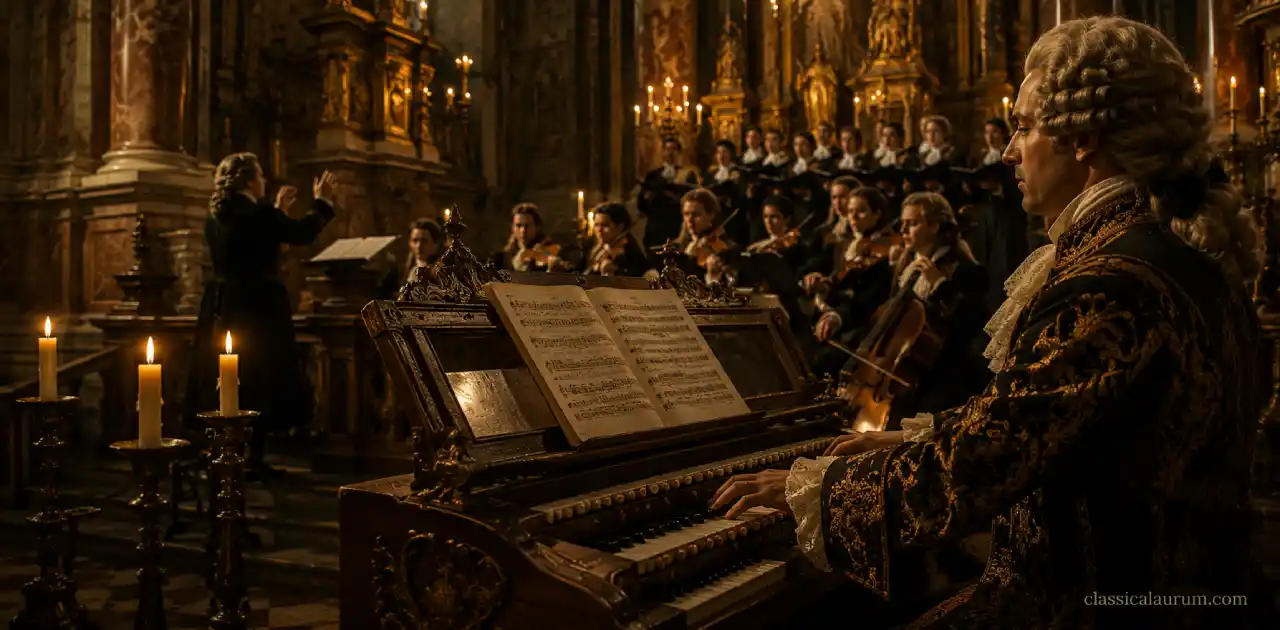
The Baroque period also saw the expansion of sacred instrumental music. The pipe organ achieved unprecedented importance inside churches. Organists developed increasingly elaborate forms, including fugues, preludes, and chorale settings.
Sacred music during this era often blurred boundaries between liturgical function and concert expression. Orchestras, soloists, and choirs combined to create vast musical canvases.
Another towering figure was George Frideric Handel, whose oratorio Messiah remains one of the most performed sacred works in the world. Although not intended strictly for church liturgy, it reflects the enduring power of biblical narrative through music.
The Baroque fascination with grandeur also influenced sacred architecture and ceremonial presentation. Music became increasingly immersive, emotional, and public.
According to Encyclopaedia Britannica, Bach’s sacred compositions continue to influence composers, theologians, conductors, and performers across multiple musical traditions.
Baroque sacred music demonstrated that religious expression could embrace complexity, virtuosity, and emotional intensity without losing spiritual focus.
Classical and Romantic Sacred Music
The Classical era introduced new ideals of balance, transparency, and formal elegance into sacred music. Yet spirituality remained central for many composers.
Wolfgang Amadeus Mozart created some of the most beloved sacred works ever written, including the Great Mass in C Minor and the unfinished Requiem. Mozart’s sacred music combines operatic lyricism with profound emotional gravity.
The Requiem especially occupies a mythical place in classical music history. Its dramatic intensity and unfinished state contributed to its legendary status.
Joseph Haydn also contributed major sacred compositions, including masses and oratorios such as The Creation, which explored spiritual themes through symphonic grandeur.
During the Romantic period, sacred music became even more emotionally expansive. Composers explored themes of mortality, redemption, suffering, transcendence, and cosmic mystery.
Giuseppe Verdi transformed the Requiem Mass into a nearly operatic dramatic experience. Meanwhile, Anton Bruckner created sacred works filled with mystical harmonic depth and monumental architecture.
The Romantic era also expanded sacred music beyond church settings. Concert performances increasingly became the primary venue for large sacred compositions.
This shift reflected broader cultural transformations in Europe. Sacred music became both devotional art and public cultural heritage.
Choirs expanded dramatically in size during the 19th century. Large choral societies emerged throughout Europe and North America, bringing sacred repertoire to wider audiences.
Even listeners without religious affiliation often experience sacred classical music as emotionally transformative. The combination of human voices, orchestral color, and spiritual themes creates a unique artistic force.
Sacred Music in the Modern World
Modern sacred music reflects a wide range of styles, philosophies, and cultural influences. Some composers preserved traditional liturgical language, while others experimented with radical harmonies and new spiritual concepts.
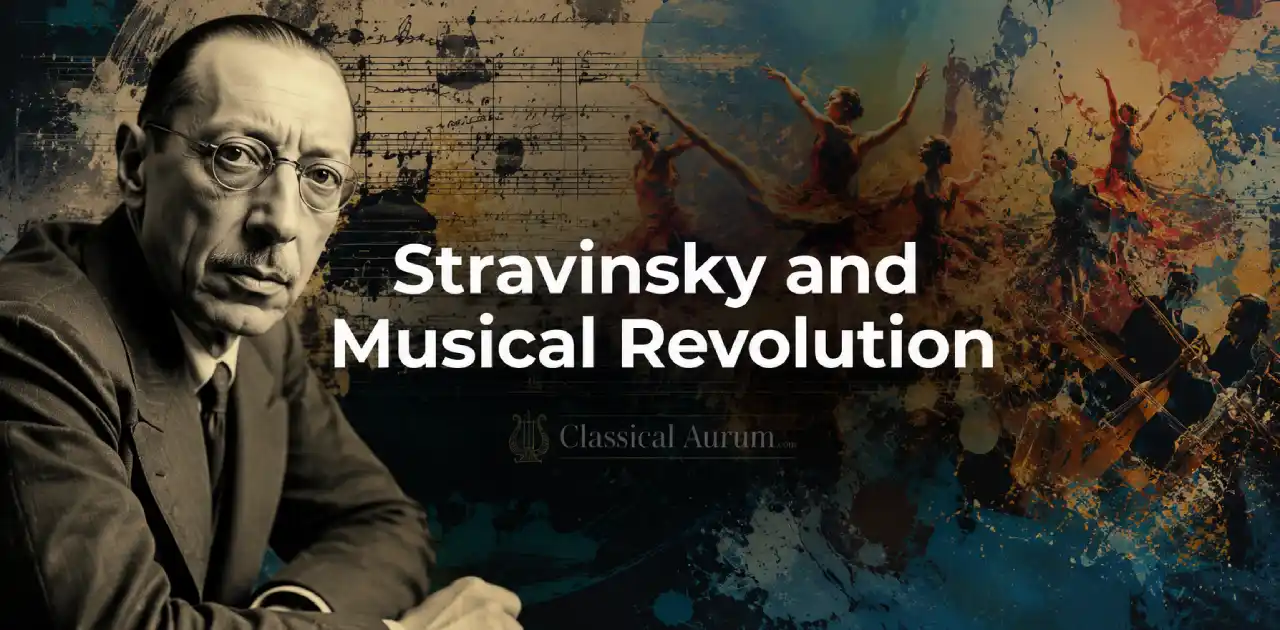
Igor Stravinsky explored sacred themes through modernist techniques in works such as the Symphony of Psalms. Arvo Pärt developed minimalist sacred language capable of profound emotional stillness.
Pärt’s tintinnabuli style became especially influential in contemporary sacred music. Its simplicity recalls Gregorian chant while speaking to modern audiences searching for silence and contemplation.
Meanwhile, composers such as John Tavener and Henryk Górecki demonstrated renewed global interest in sacred spirituality through classical composition.
Film music has also borrowed extensively from sacred traditions. Choral textures, modal harmonies, cathedral acoustics, and liturgical influences appear frequently in cinematic soundtracks associated with mystery, transcendence, or emotional gravity.
Modern sacred music often transcends denominational boundaries. Listeners from diverse backgrounds engage with sacred works for their emotional, philosophical, and aesthetic dimensions.
Streaming platforms and digital archives now allow global access to centuries of sacred repertoire. Performances once limited to cathedrals or elite concert institutions are available worldwide.
Institutions such as The Metropolitan Opera and The Berlin Philharmonic regularly present sacred repertoire that attracts audiences far beyond traditional religious communities.
For ClassicalAurum.com, sacred music remains essential because it preserves the deepest historical roots of Western classical tradition. It connects sound with architecture, spirituality, philosophy, poetry, and collective memory.
Why Sacred Music Still Matters Today
In an age dominated by speed, algorithms, and fragmented attention, sacred music offers something increasingly rare: sustained contemplation.
The great sacred traditions of Western music invite listeners into experiences that unfold slowly and deliberately. They reward concentration, silence, and emotional openness.
Sacred music also preserves continuity with centuries of cultural history. Through chant, polyphony, masses, requiems, passions, and motets, modern listeners encounter artistic languages shaped across generations.
This repertoire continues influencing composers, conductors, film scores, and contemporary choral writing. Its impact extends far beyond church settings.
Many listeners discover sacred classical music not through religion but through emotional resonance. The sound of a choir inside a cathedral, the tension of Bach’s counterpoint, or the stillness of Arvo Pärt can create deeply personal experiences.
Sacred music reminds us that classical tradition was never only entertainment. It emerged from humanity’s search for meaning, transcendence, order, and beauty.
At ClassicalAurum.com, exploring sacred music means reconnecting with one of the most enduring artistic legacies in Western civilization. From medieval monasteries to modern concert halls, sacred sound continues shaping how humanity experiences silence, emotion, memory, and the possibility of the sublime.
About the Author
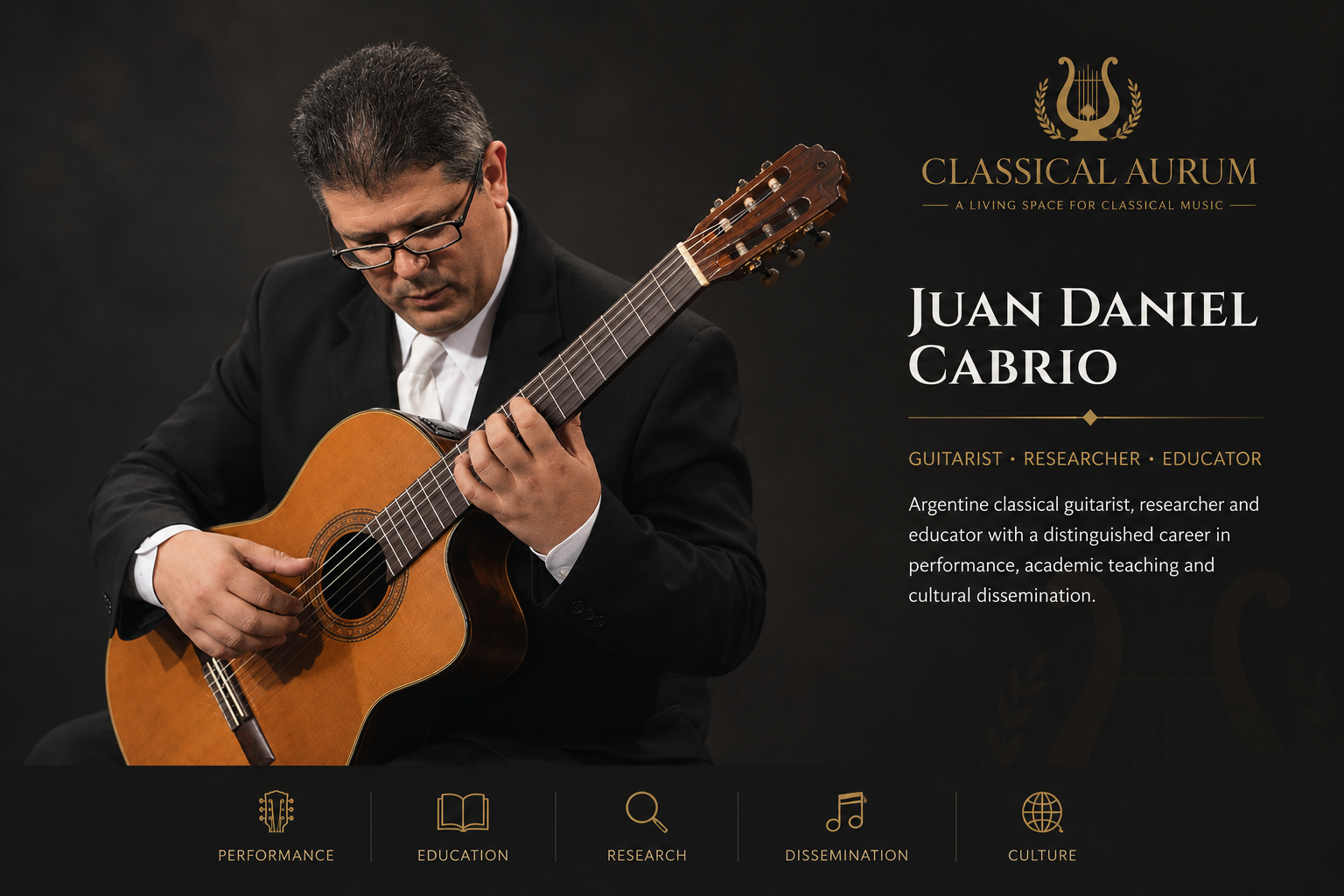
Juan Daniel Cabrio
Argentine Classical Guitarist · Researcher · Educator
Juan Daniel Cabrio is an Argentine classical guitarist, researcher and educator. Founder of Classical Aurum, he shares educational and cultural content about classical music, composers, instruments, repertoire, music history and performance practice.
View full biography