
Baroque Instruments You Should Know
Baroque Instruments You Should Know
The Baroque era (1600–1750) represents one of the most transformative periods in Western music history. It was an age of experimentation, ornamentation, contrast, and emotional intensity. The instruments developed and refined during this time shaped not only the sound of composers like Johann Sebastian Bach, Antonio Vivaldi, and George Frideric Handel, but also the foundations of modern orchestral music.
Understanding the baroque instruments you should know is essential for anyone interested in historical performance practice, classical music history, or authentic interpretation. These instruments were built differently from their modern counterparts. They used gut strings instead of steel, natural materials instead of industrial components, and relied on acoustic projection rather than mechanical amplification.
This guide explores the most important baroque instruments, their sound characteristics, and why they remain central to early music performance today.
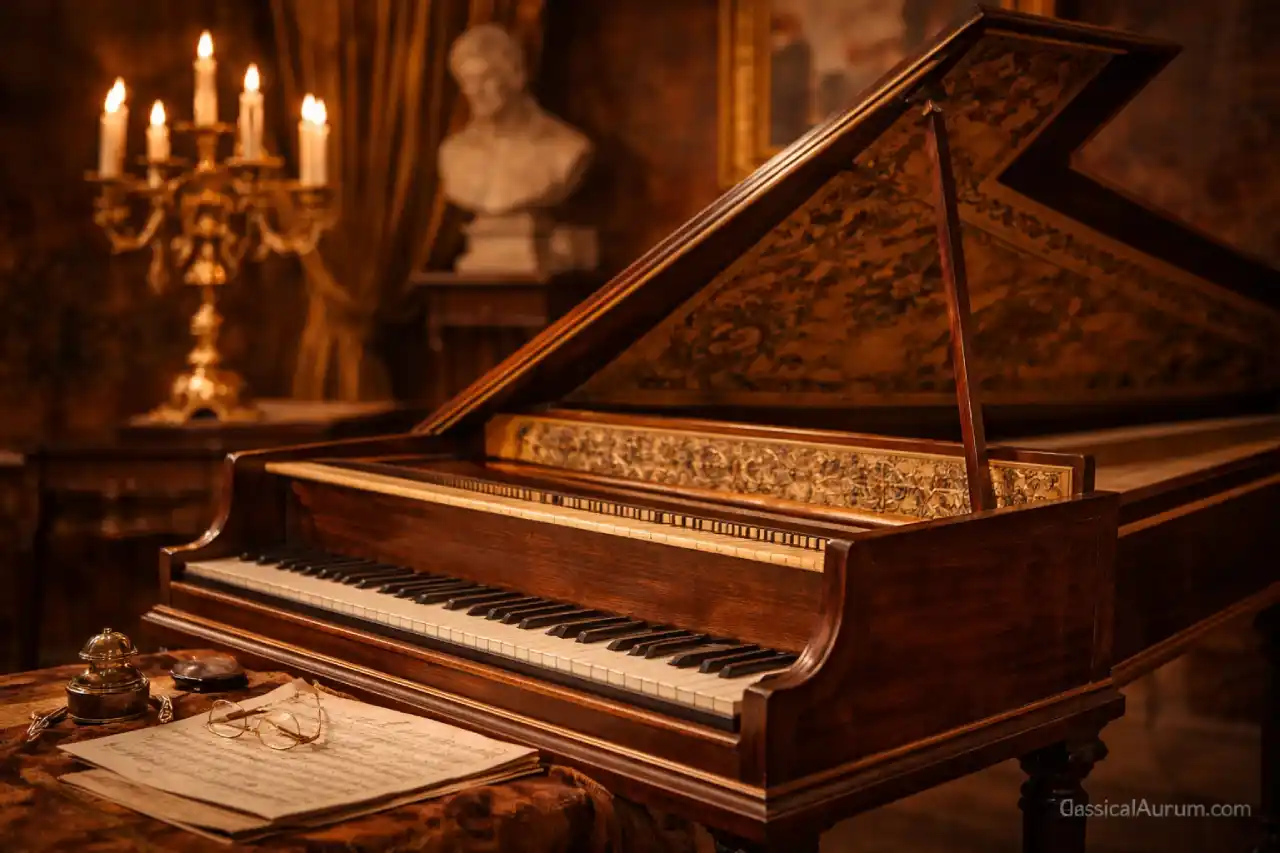
The Harpsichord: The Engine of Baroque Harmony
No instrument defines the Baroque era more clearly than the harpsichord. It was the harmonic backbone of chamber music, sacred works, and opera. Unlike the modern piano, the harpsichord produces sound by plucking strings with quills, not striking them with hammers.
This mechanism gives it a bright, articulate, and slightly metallic tone. The instrument cannot vary volume through touch. Instead, dynamic contrast is achieved through registration changes and texture variation.
The harpsichord played a central role in basso continuo, the harmonic framework underlying most Baroque compositions. A keyboardist would improvise chords over a figured bass line, often accompanied by a cello or viola da gamba.
In the music of Bach, the harpsichord becomes a solo instrument of extraordinary complexity. Handel’s operas, it supports recitatives with rhythmic clarity. In Vivaldi’s works, it anchors the harmonic pulse.
For ClassicalAurum readers, understanding the harpsichord means understanding the structural heart of Baroque music.
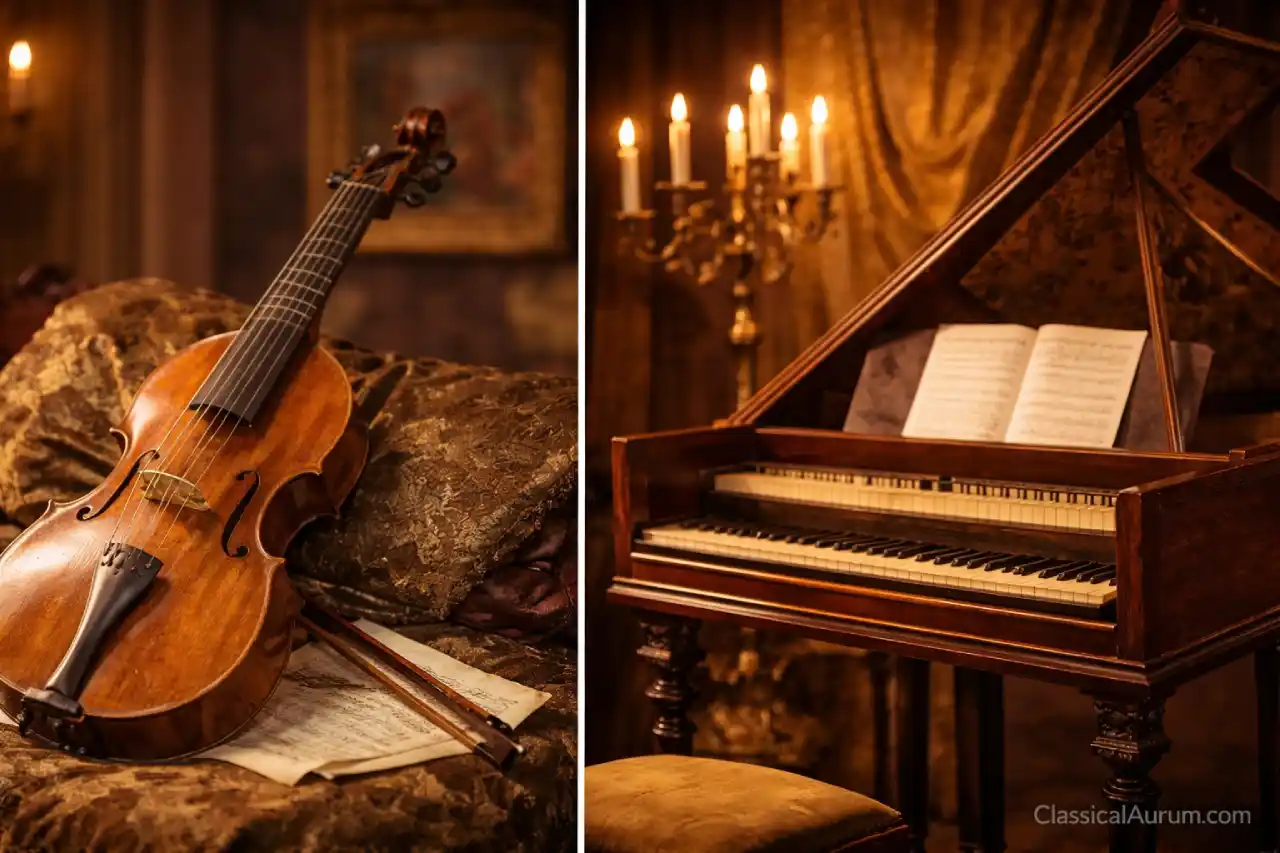
The Viola da Gamba: The Voice of Intimacy
Before the cello dominated low string writing, the viola da gamba was one of the most expressive instruments of the Baroque world. It resembles a cello but has six or seven strings, frets like a guitar, and is held between the legs.
Its sound is softer and more nuanced than the modern cello. The tone is intimate, refined, and ideal for chamber music settings. French composers like Marin Marais wrote virtuosic repertoire that highlights its lyrical qualities.
Unlike the violin family, the viola da gamba belongs to the viol family. Its tuning is closer to that of a lute, which gives it chordal flexibility and subtle harmonic color.
The instrument was particularly important in French court music and English consort music. Its expressive capacity made it ideal for conveying melancholy and introspection.
Today, historically informed performance ensembles have revived the viola da gamba, restoring its place in early music.
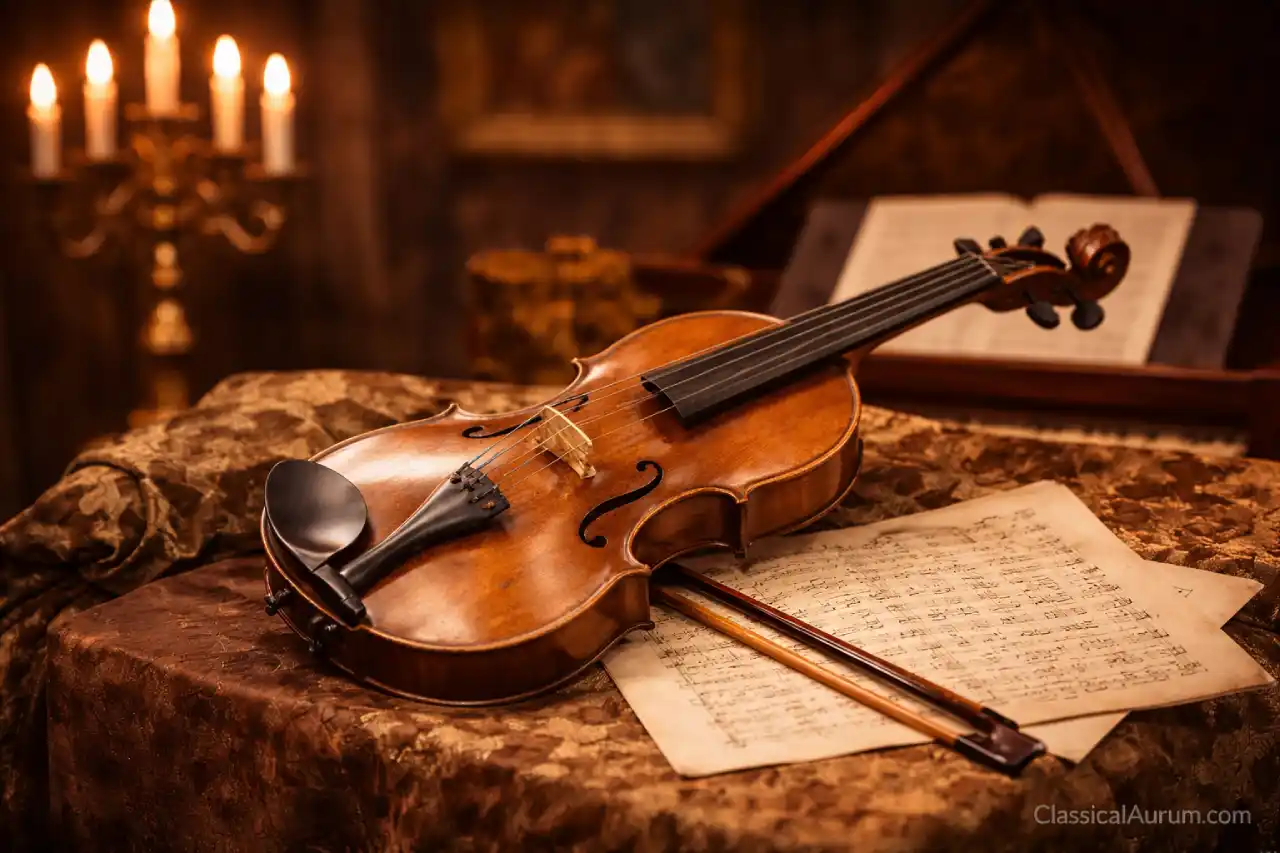
The Baroque Violin: A Different Kind of Brilliance
At first glance, a baroque violin looks similar to a modern violin. However, the differences are profound. It uses gut strings, a shorter fingerboard, and a lighter bow with a convex curve.
These features create a softer attack and a more transparent tone. The baroque violin does not project as aggressively as the modern instrument. Instead, it favors articulation, clarity, and dance-like phrasing.
Composers like Vivaldi revolutionized violin technique during this period. His concertos demand agility, rapid passagework, and expressive ornamentation.
In Bach’s Sonatas and Partitas, the baroque violin achieves polyphonic illusion without modern sustain power. This requires a completely different approach to phrasing and bow control.
For performers and listeners alike, the baroque violin offers insight into how early orchestras actually sounded.
The Theorbo and Lute: Plucked Elegance
The theorbo is one of the most visually striking baroque instruments. With its extended neck and additional bass strings, it was designed to provide harmonic depth in basso continuo.
Closely related to the lute, the theorbo produces a warm and resonant sound. Its long bass strings create a rich foundation that supports singers and instrumentalists.
Lutes were extremely popular throughout Europe. They were used in solo repertoire and as accompaniment in vocal music. Composers such as John Dowland (late Renaissance transitioning into early Baroque style) contributed to the development of plucked-string repertoire.
The theorbo became especially important in opera orchestras, particularly in Italy. Its ability to articulate harmony clearly made it indispensable in early dramatic works.
These plucked instruments remind us that Baroque texture was not always dominated by keyboards.
The Natural Trumpet: Power Without Valves
The natural trumpet differs fundamentally from the modern trumpet. It has no valves, meaning that players rely entirely on lip tension and harmonic series to produce different pitches.
This limitation results in a brilliant but somewhat restricted tonal range. However, skilled Baroque trumpeters developed extraordinary control over high harmonics.
The natural trumpet was often associated with royalty, ceremony, and sacred celebration. Bach’s cantatas and Handel’s coronation anthems showcase its majestic brilliance.
Because of tuning challenges, the instrument required exceptional precision. Its bright timbre cuts through orchestral textures, especially in festive works.
Understanding the natural trumpet reveals how composers wrote within technical constraints to achieve dramatic effect.
The Baroque Flute and Recorder: Breath and Ornament
Wind instruments in the Baroque era had a softer and more delicate tone than modern equivalents. The baroque flute, often made of wood, produces a warm and slightly veiled sound.
The recorder was also extremely popular. It was widely used in chamber music and orchestral settings.
Unlike modern metal flutes, the wooden construction emphasizes subtle color variation. Ornamentation plays a central role in phrasing.
Composers like Vivaldi wrote virtuosic flute concertos. Bach used recorders in sacred cantatas to evoke pastoral or spiritual atmospheres.
The breath-based articulation of these instruments shaped Baroque melodic style. Their tonal fragility contributes to the intimate quality of early music ensembles.
The Pipe Organ: Monumental Architecture in Sound
The pipe organ was already centuries old during the Baroque era, but it reached new heights of complexity and grandeur.
In Germany, builders created instruments with multiple manuals and elaborate pedalboards. Bach’s organ works demonstrate the full expressive potential of these instruments.
Unlike chamber instruments, the organ fills vast architectural spaces. Its sustained tone and dynamic layering allow for monumental sonic structures.
In sacred contexts, the organ symbolized divine order. Its resonance in cathedrals shaped the acoustical expectations of Baroque composers.
Even today, historically preserved Baroque organs offer insight into authentic performance practice.
Basso Continuo: The Invisible Framework
Beyond individual instruments, the concept of basso continuo defines Baroque sound. It is not a single instrument but a collaborative practice.
Typically performed by harpsichord, organ, theorbo, and a bass instrument like cello or viola da gamba, basso continuo provided harmonic support and rhythmic stability.
Musicians improvised chords from figured bass notation. This required theoretical knowledge and creative decision-making.
The continuo system reflects the improvisatory spirit of the era. It also reveals how composition and performance were deeply interconnected.
Without basso continuo, Baroque music loses its structural coherence.
Why Baroque Instruments Still Matter
The revival of historical instruments in the 20th century transformed classical performance. Ensembles dedicated to historically informed performance (HIP) began reconstructing authentic Baroque sounds.
These instruments allow modern audiences to experience the transparency, articulation, and expressive nuance intended by composers.
For ClassicalAurum readers and performers, studying baroque instruments deepens interpretive awareness. It challenges assumptions shaped by Romantic-era orchestras.
Authentic instruments reveal balance relationships within ensembles. They highlight rhetorical phrasing and dance rhythms often obscured by modern projection.
Ultimately, these instruments are not museum artifacts. They are living tools that reconnect us to a vibrant musical past.
Final Reflection
The baroque instruments you should know form the foundation of Western orchestral tradition. From the shimmering harpsichord to the solemn pipe organ, each instrument contributed to a new musical language built on contrast, ornamentation, and expressive depth.
Exploring these instruments is more than a historical exercise. It is a way to understand how sound, craftsmanship, and cultural context shaped one of the most influential periods in music history.
For performers, composers, and listeners alike, Baroque instruments open a gateway to clarity, intimacy, and artistic intention that continues to inspire centuries later.