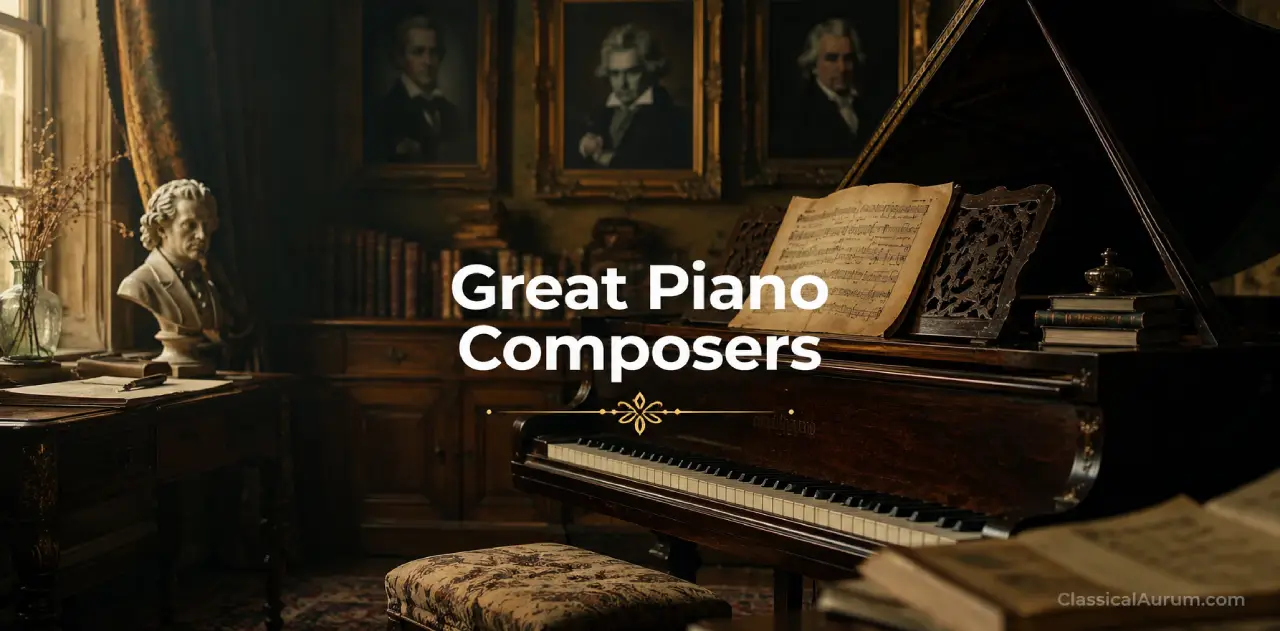
Great Piano Composers
Great Piano Composers
The history of classical music cannot be separated from the evolution of the piano. Across centuries, great piano composers transformed the instrument into a powerful medium capable of expressing emotion, drama, spirituality, virtuosity and innovation. From the elegant structures of the Classical era to the emotional intensity of Romanticism and the atmospheric textures of Impressionism, piano music became one of the defining artistic languages of Western culture.
At ClassicalAurum.com, the piano is viewed not only as an instrument, but as a historical bridge connecting composers, performers and audiences across generations. Many of the world’s most influential composers used the piano to experiment with harmony, structure and expression. Their works continue to shape modern concert repertoires, conservatory training and even film music today.
The composers explored in this article did more than write beautiful melodies. They expanded the technical possibilities of the piano, inspired new performance traditions and created works that still dominate concert halls around the world. Understanding their contributions offers valuable insight into the development of classical music itself.
Wolfgang Amadeus Mozart and the elegance of the Classical piano

Wolfgang Amadeus Mozart remains one of the foundational figures in piano music history. Although the modern piano was still developing during his lifetime, Mozart understood how to use keyboard instruments with extraordinary clarity and refinement. His piano sonatas and concertos established many of the formal standards later composers would expand upon.
Mozart’s piano writing is characterized by balance, transparency and melodic beauty. Unlike later Romantic composers who emphasized overwhelming emotion, Mozart focused on elegance and precision. His music demands technical control from performers, but it also requires subtle phrasing and expressive nuance.
Works such as the Piano Sonata No. 11 and the Piano Concerto No. 21 remain central to classical piano education and performance. The famous “Turkish March” movement introduced countless listeners to classical piano music and still attracts new audiences centuries later.
Mozart also helped define the role of the piano concerto as a dialogue between soloist and orchestra. His ability to blend sophistication with accessibility contributed greatly to the popularity of keyboard music throughout Europe. Even today, many pianists consider Mozart interpretation one of the highest artistic challenges because of the clarity and precision his music demands.
Ludwig van Beethoven and the transformation of piano expression

Ludwig van Beethoven revolutionized piano music in ways that permanently changed classical composition. He expanded the emotional range, structural complexity and dramatic power of the instrument. His music stands at the transition between the Classical and Romantic eras, combining formal discipline with intense emotional force.
Beethoven’s piano sonatas are often described as a complete artistic universe. Famous works such as the “Moonlight Sonata,” “Pathétique Sonata” and “Appassionata” introduced unprecedented emotional depth into keyboard music. These compositions pushed the technical and expressive limits of both performers and instruments.
One of Beethoven’s greatest achievements was transforming the piano into a deeply personal voice. His later sonatas became increasingly experimental, exploring new harmonic ideas and larger musical structures. Many music historians view these works as direct influences on later Romantic composers including Chopin, Liszt and Brahms.
Despite suffering severe hearing loss, Beethoven continued composing groundbreaking piano works. His artistic resilience became part of classical music mythology and elevated the image of the composer as a visionary creator struggling against adversity.
Modern concert pianists still regard Beethoven as a central pillar of the repertoire. His music demands strength, intelligence, architectural understanding and emotional honesty from interpreters.
Frédéric Chopin and the poetic soul of the piano

Frédéric Chopin is often considered the ultimate piano poet. Unlike many composers who focused on symphonies or opera, Chopin dedicated most of his artistic life to the piano itself. His music transformed the instrument into a vehicle for lyrical intimacy and emotional sophistication.
Chopin’s nocturnes, études, ballades and mazurkas introduced new levels of harmonic color and expressive flexibility. His compositions frequently combine technical difficulty with remarkable emotional sensitivity. Pianists must master delicate phrasing, rubato and tonal control to perform his works convincingly.
The études are especially important in piano history because they combined technical training with genuine artistic value. Before Chopin, technical exercises were often mechanical studies. Chopin elevated them into concert masterpieces.
His music also reflected Polish national identity. Through dances such as the mazurka and polonaise, Chopin preserved cultural traditions while simultaneously redefining Romantic piano music.
Today, Chopin remains one of the most frequently performed composers worldwide. International piano competitions dedicated to his music continue attracting elite musicians from every continent. His influence extends beyond classical music into film scores and contemporary piano culture.
Franz Liszt and the rise of the piano virtuoso

Franz Liszt changed the public image of the pianist forever. During the nineteenth century, Liszt became an international celebrity whose performances inspired admiration, hysteria and fascination throughout Europe.
Liszt’s compositions pushed piano technique to extraordinary levels. Works such as the Hungarian Rhapsodies and the Transcendental Études demanded speed, power and virtuosity rarely seen before. He explored the full sonic potential of the modern piano, using massive chords, rapid octaves and innovative textures.
Beyond technical brilliance, Liszt was also a visionary musical thinker. He pioneered the concept of the symphonic poem and supported younger composers including Wagner. His harmonic experimentation influenced later composers such as Debussy and Ravel.
Liszt also contributed significantly to modern concert culture. He popularized the solo piano recital format, performed from memory and positioned the piano sideways on stage so audiences could better observe the performer. These practices became standard in classical performance tradition.
Although some critics initially viewed Liszt as excessively theatrical, modern scholarship increasingly recognizes the depth and originality of his compositions. His music combines spiritual reflection, dramatic intensity and astonishing pianistic innovation.
Claude Debussy and the birth of musical Impressionism

Claude Debussy introduced a completely new sound world into piano music. Rejecting the heavy emotional rhetoric of late Romanticism, Debussy focused on atmosphere, color and subtle harmonic movement.
His piano works often resemble paintings or landscapes translated into sound. Pieces such as “Clair de Lune,” “La Cathédrale engloutie” and the Préludes create vivid sonic imagery through innovative harmonies and delicate textures.
Debussy’s influence extended far beyond France. He transformed twentieth-century music by weakening traditional tonal expectations and encouraging composers to think differently about harmony and rhythm. Many modern film composers and contemporary pianists continue drawing inspiration from his atmospheric style.
Performing Debussy requires exceptional tonal sensitivity. Rather than emphasizing power, his music often demands refined pedaling, transparency and control of color. Pianists must shape subtle shades of sound rather than relying solely on virtuosity.
The popularity of Debussy’s piano music demonstrates how audiences remain deeply attracted to musical impressionism and emotional ambiguity. His works continue to provide moments of reflection and beauty in modern concert programming.
Sergei Rachmaninoff and the grandeur of late Romantic piano music

Sergei Rachmaninoff represented one of the last great voices of Romantic piano composition. His music combines sweeping melodies, emotional intensity and extraordinary technical challenges.
Rachmaninoff was not only a composer but also one of the greatest pianists of his era. His large hands and remarkable technique allowed him to perform passages considered nearly impossible for many musicians. This virtuosity shaped his compositional language.
Works such as the Piano Concerto No. 2 and Prelude in C-sharp minor became iconic pieces of the piano repertoire. His music often conveys nostalgia, melancholy and dramatic passion, qualities that resonate strongly with audiences even today.
During the twentieth century, some critics considered Rachmaninoff old-fashioned because he maintained Romantic traditions while modernism expanded across Europe. However, contemporary audiences and performers continue embracing his music enthusiastically.
Rachmaninoff’s enduring popularity demonstrates that emotional communication remains central to classical music appreciation. His compositions connect directly with listeners through powerful melodies and monumental piano writing.
Why great piano composers still matter today
The legacy of the great piano composers extends far beyond concert halls. Their music influences cinema, education, digital media and contemporary composition. Young pianists across the world still begin their training with works by Mozart, Beethoven and Chopin because these composers established the foundations of piano technique and musical interpretation.
Modern technology has also expanded access to classical piano music. Streaming platforms, online lessons and digital archives allow audiences worldwide to discover masterpieces once limited to elite cultural institutions. According to The Juilliard School, classical piano education continues evolving through global accessibility and interdisciplinary approaches.
The piano itself remains one of the most versatile instruments in music history. Its ability to produce harmony, melody and rhythm simultaneously gives composers enormous creative freedom. This versatility explains why the piano became central to Western musical development for more than two centuries.
At the same time, historical interpretation practices continue evolving. Musicians now study period instruments, historical manuscripts and original performance traditions to better understand how these masterpieces were intended to sound. Organizations such as Carnegie Hall and Royal Academy of Music regularly promote both historical scholarship and contemporary performance innovation.
For listeners, exploring the works of great piano composers offers more than entertainment. These compositions reflect philosophical ideas, political changes, cultural transformations and personal struggles across centuries of human history.
The eternal power of piano music
The piano remains one of the most beloved instruments in classical music because of the composers who dedicated their creativity to it. Mozart gave the piano elegance and clarity. Beethoven expanded its emotional universe. Chopin transformed it into poetry. Liszt elevated virtuosity into spectacle. Debussy introduced color and atmosphere. Rachmaninoff preserved Romantic grandeur in a rapidly changing world.
Together, these composers created a musical tradition that continues inspiring performers and audiences globally. Their works remain central to classical culture because they speak directly to human emotion while simultaneously demonstrating extraordinary artistic craftsmanship.
For readers of ClassicalAurum.com, the exploration of great piano composers is also an exploration of musical civilization itself. Each composition carries traces of history, innovation and personal expression that continue resonating across generations.
The enduring popularity of piano music proves that classical masterpieces are not relics of the past. They remain living works capable of moving modern audiences with the same emotional force they possessed centuries ago.