








Heitor Villa-Lobos and Modern Guitar Music
Heitor Villa-Lobos: A Bridge Between Worlds
Few composers have reshaped the identity of the classical guitar as profoundly as Heitor Villa-Lobos. Born in Brazil in 1887, Villa-Lobos emerged as a unique voice who fused European classical traditions with the vibrant rhythms and colors of Brazilian folk music. His work not only expanded the guitar repertoire but also helped redefine what modern guitar music could become.
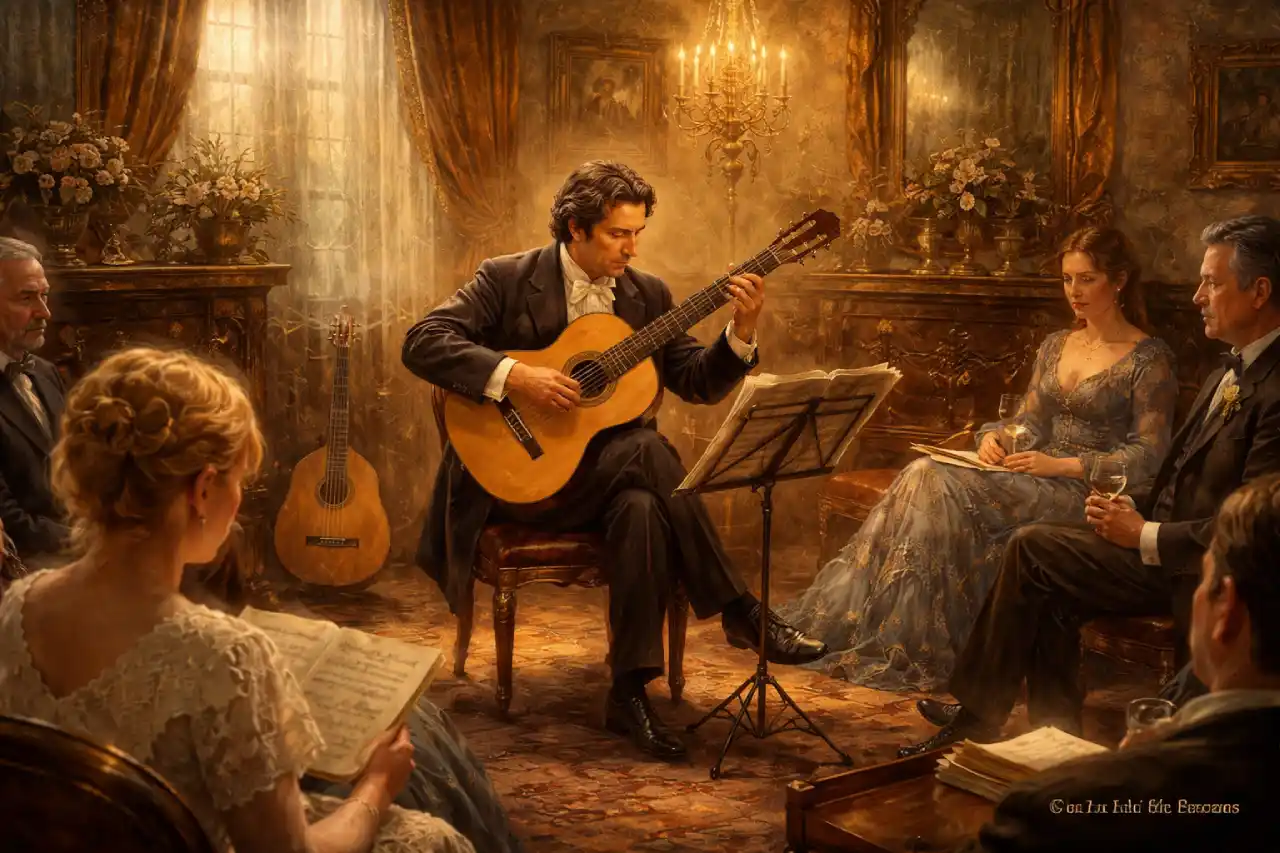
Before Villa-Lobos, the guitar was often seen as a salon instrument—intimate, expressive, yet limited in scope. His compositions challenged this perception by introducing structural complexity, rhythmic vitality, and orchestral thinking into guitar writing.
For ClassicalAurum.com, Villa-Lobos represents a key turning point: a composer who transformed the guitar into a concert instrument of global significance, capable of conveying both intellectual depth and raw emotional power.
Related: Heitor Villa-Lobos and Modern Guitar Music
The Guitar Before Villa-Lobos
To understand his impact, it is essential to consider the state of guitar music before his arrival. The 19th century had produced important composers such as Fernando Sor and Francisco Tárrega, who elevated the guitar technically and musically. However, their works remained largely rooted in European Romantic traditions.
By the early 20th century, the guitar was still fighting for recognition in major concert halls. Its repertoire, though refined, lacked the modernist expansion seen in piano and orchestral music.
Villa-Lobos entered this landscape with a radically different vision. He did not treat the guitar as a delicate instrument but as a percussive, harmonic, and rhythmic universe.

The Revolutionary Études
Villa-Lobos’s Twelve Études (1929) are among the most important contributions to modern guitar music. Dedicated to Andrés Segovia, these études transcend their pedagogical purpose and become concert masterpieces.
Each étude explores a specific technical challenge—arpeggios, scales, chords—but within a rich musical framework. Unlike traditional études, these works are not merely exercises; they are expressive narratives.
What makes them revolutionary is the integration of:
- Brazilian rhythmic patterns
- Expanded harmonic language
- Unconventional textures
The études demand not only technical mastery but also interpretive depth, making them a cornerstone of any serious guitarist’s repertoire.

Five Preludes: A New Emotional Landscape
The Five Preludes (1940) represent another milestone. These pieces are shorter and more lyrical than the études but equally profound.
Each prelude reflects a different aspect of Brazilian culture:
- Melancholy urban life
- Indigenous heritage
- Social dances
- Romantic nostalgia
- Rural landscapes
Villa-Lobos combines simplicity and sophistication, creating music that feels both accessible and deeply complex. The preludes are often the entry point for guitarists into his world, yet they continue to challenge performers at every level.
Brazilian Identity in Classical Form
One of Villa-Lobos’s greatest achievements is his ability to integrate national identity into classical structure without reducing it to folklore.
Rather than quoting folk melodies directly, he absorbed their essence:
- Syncopated rhythms
- Modal harmonies
- Improvisational gestures
This approach allowed him to create a universal language rooted in Brazilian culture but understood worldwide.
For Classical Aurum’s editorial vision, this represents a key idea: music as a bridge between local identity and global expression.
Influence on Modern Guitar Technique
Villa-Lobos expanded the technical possibilities of the guitar in ways that still influence performers today.
His innovations include:
- Complex polyphony on a single instrument
- Use of extended chord voicings
- Integration of percussive effects
- Exploration of the guitar’s full tonal range
These elements forced guitarists to rethink their approach, moving beyond traditional fingerstyle into a more orchestral mindset.
Modern guitarists owe much of their technical vocabulary to Villa-Lobos’s experimentation.
Collaboration with Andrés Segovia
The relationship between Villa-Lobos and Andrés Segovia was crucial for the dissemination of his works.
Segovia, one of the most influential guitarists of the 20th century, recognized the value of Villa-Lobos’s music and brought it to international audiences. However, their collaboration was not without tension.
Segovia often edited Villa-Lobos’s compositions to fit his own aesthetic preferences, sometimes simplifying passages. Despite this, the partnership ensured that these works became central to the global guitar repertoire.
Beyond the Guitar: A Universal Composer
Although best known for his guitar works, Villa-Lobos composed extensively for orchestra, chamber ensembles, and voice.
His Bachianas Brasileiras series exemplifies his ability to merge Johann Sebastian Bach’s contrapuntal style with Brazilian musical elements. This synthesis mirrors what he achieved with the guitar: a dialogue between traditions.
Understanding his broader output helps guitarists interpret his works with greater depth, recognizing the orchestral thinking behind his writing.
Villa-Lobos in the Modern Repertoire
Today, Villa-Lobos is a pillar of modern guitar music. His works are performed worldwide, studied in conservatories, and recorded by leading artists.
His influence can be seen in composers such as:
- Leo Brouwer
- Roland Dyens
- Sérgio Assad
These composers continue to explore the possibilities opened by Villa-Lobos, blending technical innovation with cultural identity.
For ClassicalAurum.com, this continuity is essential: Villa-Lobos is not just a historical figure but a living force in contemporary music.
Interpretation: More Than Technique
Playing Villa-Lobos requires more than technical precision. His music demands:
- Rhythmic flexibility
- Deep understanding of Brazilian musical character
- Balance between structure and spontaneity
Performers must navigate between written notation and an almost improvisational spirit, capturing the organic flow that defines his style.
This duality—discipline and freedom—is at the heart of modern guitar interpretation.
A Lasting Legacy
Heitor Villa-Lobos transformed the guitar into a modern, expressive, and globally respected instrument. His works continue to inspire performers, composers, and audiences alike.
For the Classical Aurum Project, his legacy aligns perfectly with the mission of exploring music that connects tradition, innovation, and human expression.
His music is not merely part of the repertoire—it is a gateway to understanding the evolution of the modern guitar.