



Order, Beauty, and Meaning in Sound
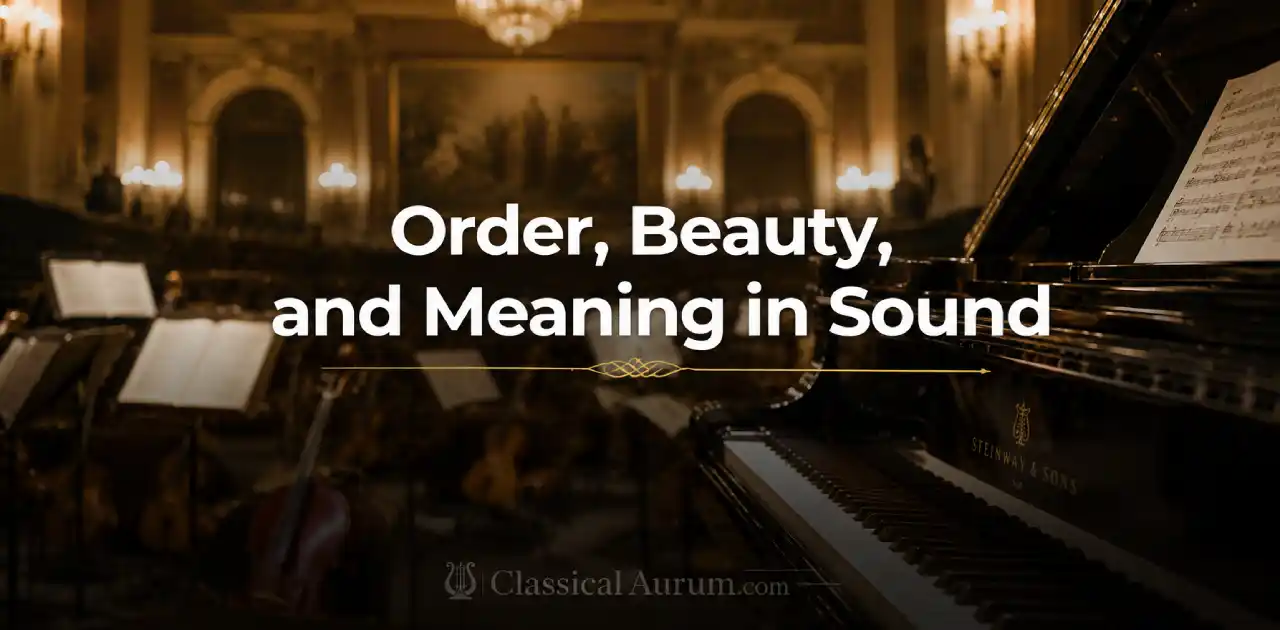
Order, Beauty, and Meaning in Sound
Music has accompanied human civilization for thousands of years. Across cultures and historical periods, people have searched for patterns that transform simple sounds into experiences capable of moving the mind and the emotions. In the world of classical music, this search has often centered on three interconnected ideas: order, beauty, and meaning.
These concepts are not isolated. Order gives coherence to sound, beauty creates emotional resonance, and meaning allows music to communicate beyond words. Together, they form the foundation of musical art and explain why great compositions continue to inspire audiences centuries after they were written.

The Human Need for Order in Music
Human beings naturally seek patterns. The mind recognizes repetition, balance, and symmetry, turning individual sounds into organized structures. Music becomes understandable because it follows relationships that listeners can perceive, even unconsciously.
Rhythm provides one of the clearest examples of order. Regular pulses create stability and help listeners anticipate what comes next. Melodies also depend on order, since sequences of notes gain significance through their relationships rather than through isolated sounds.
Classical composers have long relied on organizational principles. From the fugues of Johann Sebastian Bach to the sonata forms of Mozart and Beethoven, musical architecture creates unity and direction. The listener experiences a sense of progression because every element contributes to a larger design.
Without order, sound becomes random noise. Structure transforms acoustic events into artistic expression.

Harmony and the Search for Beauty
Beauty in music has fascinated philosophers, musicians, and audiences throughout history. Although personal tastes vary, certain qualities consistently appear in works considered beautiful.
Harmony plays a central role in this experience. Consonance and balance create sensations of stability, while carefully controlled dissonance introduces tension and release. This dynamic relationship gives music emotional depth.
In classical traditions, beauty is not simply pleasant sound. It often emerges from contrast, proportion, and expressive richness. A quiet passage may become beautiful because it follows dramatic intensity. Likewise, a simple melody can acquire extraordinary significance when supported by sophisticated harmonic language.
Many composers pursued beauty through clarity and elegance. Mozart’s music is admired for its balance and transparency, while Chopin created beauty through lyrical expression and harmonic color. Despite their differences, both composers demonstrated that beauty can take multiple forms.
The concept of beauty evolves with time, yet the desire to encounter it remains constant.

Meaning Beyond Words
Unlike literature or painting, music does not usually communicate through precise verbal definitions. Nevertheless, listeners often experience powerful feelings and personal interpretations.
Meaning in music operates on several levels. Some works have explicit programs or narratives. Others evoke emotions without describing specific events. A symphony may suggest struggle, hope, or contemplation without providing a fixed storyline.
Because music is abstract, each listener contributes to its meaning. Personal memories, cultural experiences, and emotional states influence perception. The same composition can inspire different responses in different individuals.
This openness explains why classical masterpieces remain relevant across generations. Their meanings are not limited to a single historical context. Instead, they continue to speak to listeners in changing circumstances.
Music becomes a meeting point between composer, performer, and audience.
Ancient Ideas About Sound and Harmony
The relationship between order and beauty has ancient roots. Greek philosophers believed that numerical relationships governed both music and the universe itself.
Pythagoras discovered mathematical connections between vibrating strings and musical intervals. These findings suggested that harmony reflected deeper principles present in nature. The idea influenced centuries of musical thought and contributed to the concept of cosmic order.
During the Middle Ages and the Renaissance, scholars viewed music as part of a broader intellectual framework. Musical proportions were associated with mathematics, astronomy, and philosophy. Sound was understood as an expression of universal balance.
Even though modern science approaches these questions differently, the fascination with harmony and structure continues. Contemporary acoustics confirms that physical laws shape the sounds humans perceive.
The connection between mathematics and beauty remains one of the most intriguing aspects of music.
Form and Architecture in Classical Music
Large-scale musical forms reveal how order creates meaning. Composers organize themes, contrasts, and developments to guide the listener through a coherent experience.
Sonata form, for example, presents musical ideas, develops them, and eventually resolves tensions. This process resembles storytelling, even without words. The listener senses departure, conflict, and return.
Fugues demonstrate another type of order. Through imitation and contrapuntal interaction, a single theme generates complex textures while preserving unity. Bach’s works illustrate how intellectual rigor can coexist with emotional power.
Symphonies, concertos, and chamber music all depend on architectural thinking. Their structures provide stability while allowing expressive freedom.
The balance between discipline and creativity is one of the defining characteristics of classical composition.
Why Beauty Is Not Always Simplicity
Many people associate beauty with smooth melodies and consonant harmonies. However, classical music demonstrates that beauty can also emerge from complexity and tension.
Beethoven expanded traditional forms and introduced dramatic contrasts. Wagner transformed harmonic language and prolonged musical tension. Twentieth-century composers explored new sounds that challenged conventional expectations.
Initially, some works were considered difficult or controversial. Over time, audiences learned to appreciate their expressive depth. Beauty proved to be more flexible than previously imagined.
This evolution reminds us that artistic perception changes with experience. Listening habits develop gradually, allowing greater understanding of unfamiliar styles.
Beauty is therefore not a fixed formula. It is a living relationship between sound and perception.
The Role of Performers in Creating Meaning
A musical score contains instructions, but it does not produce sound by itself. Performers bring compositions to life through interpretation, technique, and artistic sensitivity.
Two musicians can perform the same piece and create very different experiences. Tempo choices, phrasing, articulation, and tone color influence emotional impact. Interpretation becomes a bridge between the composer’s intentions and the listener’s imagination.
Great performers combine respect for the score with personal expression. Their decisions reveal hidden details and deepen the meaning of familiar works.
This process explains why classical music remains dynamic rather than static. Each performance represents a new encounter with the same artistic material.
The relationship between composition and interpretation enriches the musical experience.
Silence as Part of Meaning
Sound alone does not create music. Silence also contributes to expression and structure.
Pauses generate expectation and allow listeners to absorb what they have heard. Strategic moments of silence can intensify emotion more effectively than continuous sound.
Many composers understood the expressive power of absence. Mozart used silence to create elegance and balance. Beethoven employed dramatic pauses to heighten tension. Modern composers explored silence itself as an artistic element.
These moments remind us that music exists within time. Meaning often emerges not only from what is heard but also from what is temporarily withheld.
Silence gives shape to sound and helps define musical form.
Why Classical Music Continues to Matter
Despite technological changes and evolving cultural trends, classical music continues to attract listeners worldwide. Its endurance reflects the universal importance of order, beauty, and meaning.
People seek experiences that transcend daily routines. Music offers emotional depth, intellectual stimulation, and opportunities for reflection. Great compositions reveal that artistic value is not dependent on historical fashion.
Classical music also encourages attentive listening. In a world dominated by speed and constant information, it invites patience and contemplation.
The masterpieces of the past remain alive because they address fundamental aspects of human existence. They speak about joy, sorrow, hope, struggle, and wonder.
These themes are timeless.
Conclusion
Order, beauty, and meaning in sound form the essence of musical art. Structure gives coherence, beauty awakens emotion, and meaning connects music with human experience.
Throughout history, composers and performers have explored these principles in countless ways. Their works demonstrate that sound can become far more than a physical phenomenon. It can become a language of emotion, reflection, and shared humanity.
For listeners of classical music, every composition represents an invitation to discover patterns, experience beauty, and create personal meaning. This ongoing dialogue between sound and consciousness explains why music remains one of humanity’s greatest artistic achievements.
At ClassicalAurum.com, the appreciation of music goes beyond technical analysis. It embraces the profound relationship between artistic order and the human search for beauty and meaning.