
Sonata Form Made Simple
Sonata Form Made Simple
Sonata form is one of the most important structures in Western classical music. It shaped symphonies, chamber music, concertos, and piano sonatas throughout the Classical period and beyond. Yet for many students and listeners, it feels abstract or intimidating.
This guide to Sonata Form Made Simple explains the structure clearly and practically. We will break down its three essential sections, explore how composers use contrast and development, and understand why this form became the backbone of Classical musical thought.
At ClassicalAurum.com, our goal is not just to define theory, but to illuminate how structure creates expressive meaning.
Why Sonata Form Matters in Classical Music
Sonata form became the dominant musical architecture of the late 18th century. Composers like Joseph Haydn, Wolfgang Amadeus Mozart, and Ludwig van Beethoven used it to organize musical drama with clarity and logic.
It is most commonly found in:
-
First movements of symphonies
-
First movements of sonatas
-
Chamber music works
-
Overtures
Sonata form reflects Enlightenment ideals: balance, contrast, rational development, and resolution. It transforms musical ideas into a narrative journey.
At its core, sonata form is built on tension and return. It presents musical material, destabilizes it, and ultimately restores equilibrium.
Understanding this process allows listeners to follow large-scale musical storytelling.
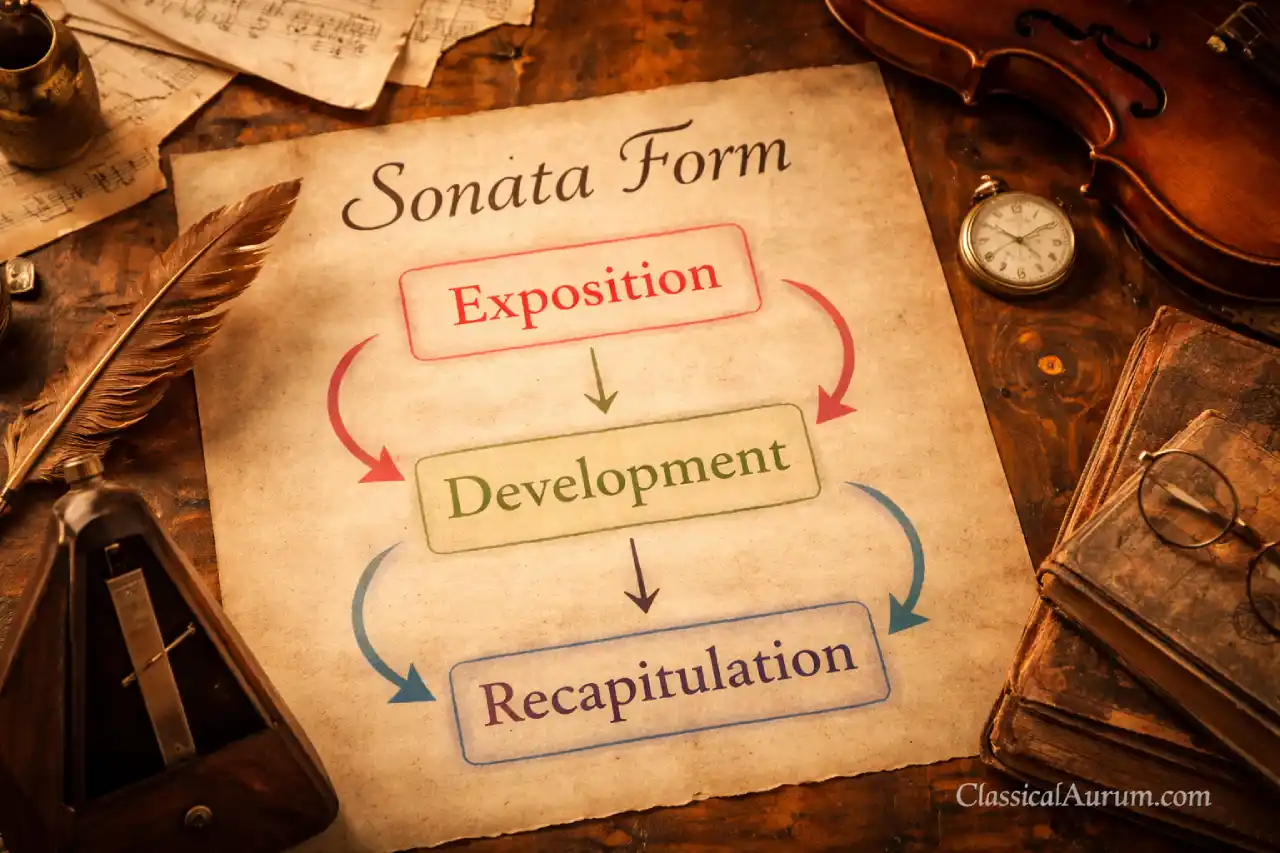
The Three Main Sections of Sonata Form
Sonata form is traditionally divided into three primary sections:
-
Exposition
-
Development
-
Recapitulation
Some movements also begin with a slow introduction and end with a coda, but the heart of the form lies in these three structural pillars.
Let’s examine each one carefully.
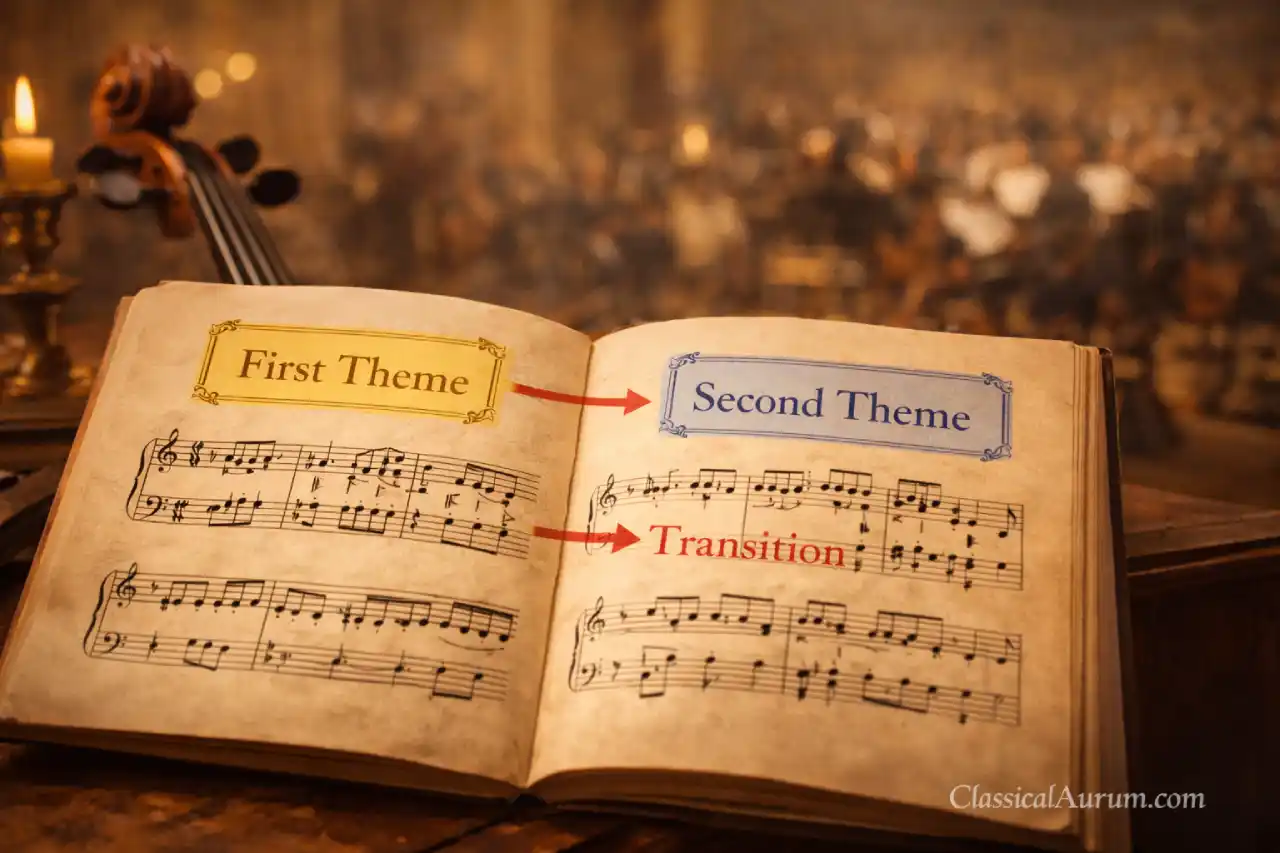
The Exposition: Presenting the Musical Ideas
The exposition introduces the principal themes. It typically contains two contrasting thematic groups.
First Theme (Primary Theme):
-
Presented in the home key (tonic)
-
Strong and clearly defined
-
Establishes tonal identity
Transition (Bridge):
-
Modulates away from the tonic
-
Creates forward momentum
-
Prepares for contrast
Second Theme (Secondary Theme):
-
Appears in a new key
-
Major works: usually dominant key
-
Minor works: often relative major
-
-
Often more lyrical or contrasting in character
Closing Section:
-
Reinforces the new key
-
Brings exposition to a decisive cadence
The exposition is usually repeated. This repetition ensures that listeners internalize the main thematic material.
In a Mozart symphony, for example, the first theme may feel assertive and structured, while the second theme flows with elegance and lyricism. The contrast is deliberate and structural.
The Development: Transformation and Instability
If the exposition presents ideas, the development challenges them.
The development section is the most harmonically unstable and dramatic part of sonata form. Composers fragment themes, sequence motifs, and explore distant keys.
Key characteristics include:
-
Modulation to remote tonal areas
-
Motivic fragmentation
-
Increased tension
-
Harmonic unpredictability
In Beethoven’s works, the development often becomes a battlefield of ideas. A simple motif introduced in the exposition may be broken apart, inverted, or rhythmically intensified.
This section generates suspense. The listener senses instability and anticipates resolution.
The development usually ends with a dominant preparation — a long build-up that leads back to the tonic key. This prepares the ear for the return.
The Recapitulation: Return and Resolution
The recapitulation resolves the harmonic tension.
Main themes return, but with one crucial difference: everything remains in the tonic key.
Structure of the recapitulation:
-
First Theme in tonic
-
Transition adjusted to avoid modulation
-
Second Theme now in tonic
-
Closing material in tonic
This tonal unification provides structural closure.
In the exposition, the second theme created contrast by shifting to a new key. In the recapitulation, that contrast is resolved through tonal alignment.
This is not just repetition. It is transformation through stability.
The listener experiences emotional completion.
Optional Elements: Introduction and Coda
Many sonata-form movements include additional framing elements.
Slow Introduction:
-
Often dramatic
-
Establishes mood
-
May foreshadow themes
Coda:
-
Extends the ending
-
Reinforces tonic resolution
-
Can become expansive in Romantic works
Beethoven expanded the coda dramatically, sometimes making it feel like a second development. This innovation influenced later composers such as Johannes Brahms.
The coda allows composers to reaffirm the tonal center and deliver emotional finality.
Major vs. Minor Key Differences
The key relationships in sonata form follow patterns, but they adapt depending on mode.
In major-key movements:
-
Second theme usually in dominant key
In minor-key movements:
-
Second theme often in relative major
This tonal contrast enhances expressive range.
For example, a minor-key sonata may introduce drama and darkness in the first theme, then shift to warmth in the relative major for the second theme.
The recapitulation eliminates this tonal duality by keeping both themes in the tonic minor.
This structural consistency reinforces unity.
Sonata Form in Symphonies and Concertos
Sonata form is not limited to solo piano works. It is foundational in large orchestral repertoire.
In symphonies by Haydn and Mozart, the first movement almost always follows sonata form.
In concertos, the structure often merges with ritornello elements. The orchestra may present themes before the soloist enters.
Beethoven expanded sonata form dramatically in his symphonies, particularly in the Eroica Symphony, stretching development sections and codas beyond traditional expectations.
Sonata form thus evolved from balanced Classicism into expressive Romantic expansion.
Common Misunderstandings About Sonata Form
Many students think sonata form is rigid. It is not.
Composers treated it as a flexible framework.
Some works blur boundaries between sections. Others introduce thematic transformations that challenge textbook definitions.
The goal is not mechanical repetition, but organic growth.
Sonata form is best understood as a dynamic process:
Presentation → Conflict → Resolution
It mirrors narrative structure found in literature and drama.