




Haydn, Mozart, and the Birth of the Symphony
The symphony did not emerge fully formed. It evolved gradually, shaped by experimentation, patronage systems, court orchestras, and the creative genius of composers who redefined instrumental music.
Among them, Joseph Haydn and Wolfgang Amadeus Mozart stand at the center of the transformation. Their contributions did not merely refine an existing genre—they defined what a symphony could be.
At Classical Aurum, we explore the symphony not only as a musical form but as a turning point in Western artistic consciousness: a moment when instrumental music achieved philosophical depth, structural sophistication, and emotional range equal to vocal genres.
Related: Folk Roots in Art Music
From Sinfonia to Symphony: Origins of an Orchestral Form
Before Haydn and Mozart, the symphony evolved from the Italian sinfonia, an overture used in opera during the early 18th century. These works typically followed a fast–slow–fast structure and served as introductory gestures rather than independent artistic statements.
Composers such as Giovanni Battista Sammartini and Johann Stamitz began expanding the form. The Mannheim school introduced dynamic contrasts, orchestral crescendos, and thematic clarity. Yet these early symphonies remained relatively brief and structurally simple.
Related: Nationalism in Classical Music
By mid-century, instrumental music was gaining prestige. Enlightenment thought emphasized reason, balance, and clarity—values mirrored in emerging Classical style. Orchestras grew in size and discipline. Audiences began listening to instrumental works with focused attention rather than treating them as background entertainment.
The stage was set for transformation.
What the symphony needed was architectural depth, motivic development, and structural coherence. It required a composer willing to experiment across decades. That composer was Haydn.
Related: The Evolution of the Symphony
Joseph Haydn: Architect of the Classical Symphony
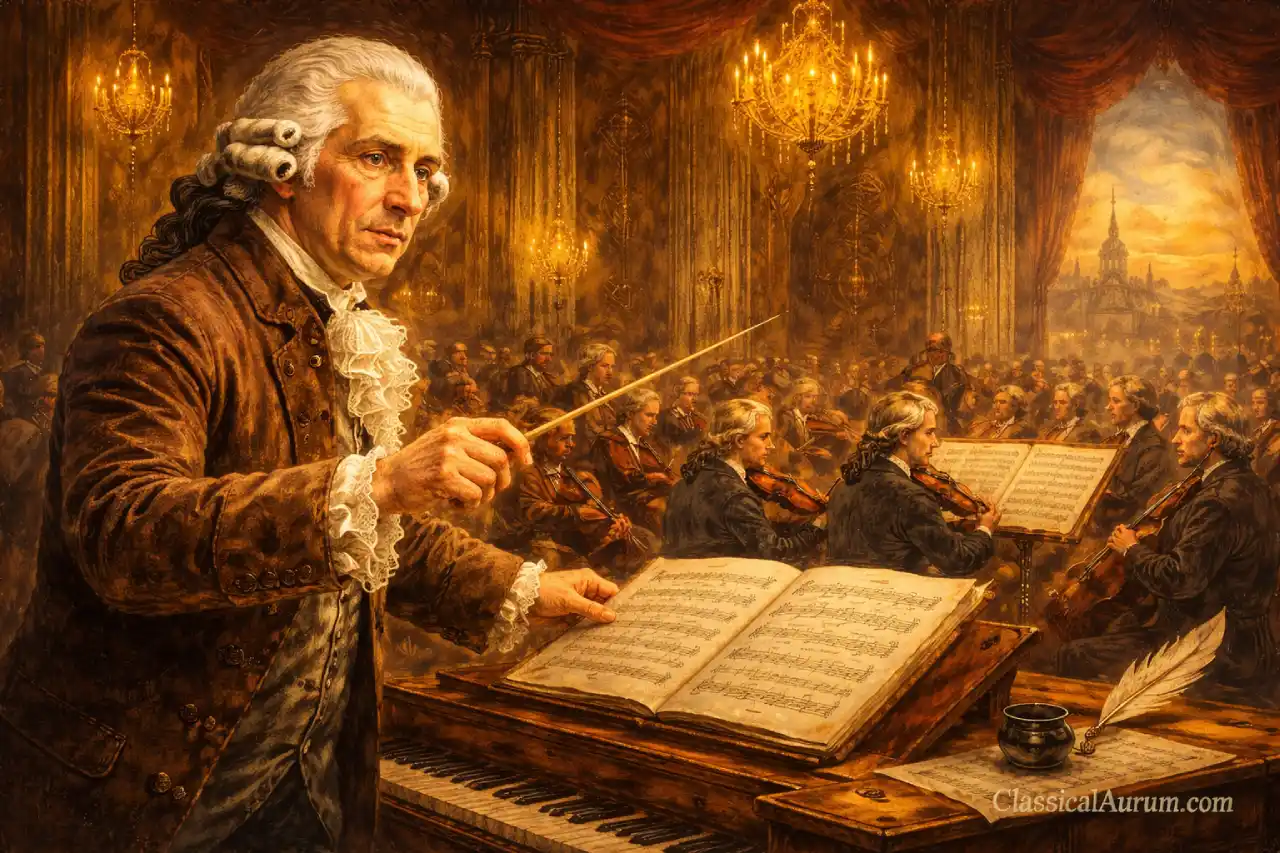
Joseph Haydn composed over 100 symphonies across nearly four decades. His career at the Esterházy court provided unusual stability, allowing him to experiment without constant public pressure.
Haydn did not invent the symphony—but he systematized it.
He established the four-movement structure that became standard:
-
Fast movement (often in sonata form)
-
Slow movement
-
Minuet and trio
-
Fast finale
His genius lay in development. Themes were not merely presented; they were transformed, fragmented, inverted, and recombined. The symphony became a dynamic conversation between musical ideas.
Haydn also introduced humor, surprise, and dramatic pacing. The “Surprise” Symphony No. 94 features a sudden loud chord in a quiet passage—an example of his theatrical intelligence.
Orchestration matured under Haydn’s hand. Winds gained independence. Strings developed textural richness. Structural clarity and emotional subtlety coexisted.
By the time of his London symphonies (Nos. 93–104), the genre had reached unprecedented grandeur. Public concerts in London demonstrated that the symphony was no longer courtly entertainment—it was a major artistic statement.
Haydn transformed the symphony into a self-contained intellectual and emotional journey.
Mozart’s Symphonic Voice: Lyricism and Drama
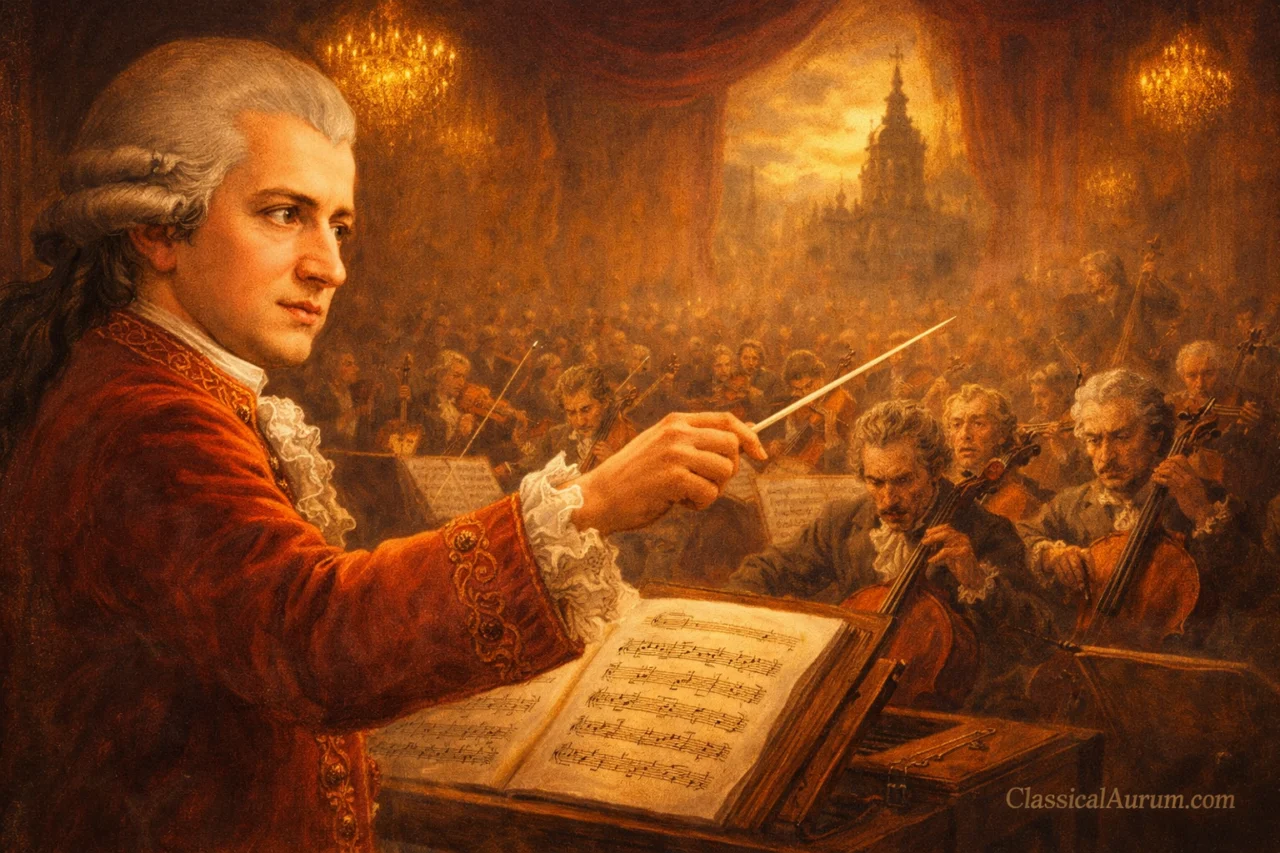
Wolfgang Amadeus Mozart inherited Haydn’s structural achievements but infused them with lyrical intensity and operatic drama.
Mozart composed over 40 symphonies, many written in his youth. His early works show stylistic influence from Italian models and the Mannheim school. Yet his mature symphonies reveal extraordinary depth.
The final three symphonies—Nos. 39, 40, and 41 (Jupiter)—represent the summit of Classical symphonic art.
Mozart’s symphonic language is distinguished by:
-
Operatic melodic expression
-
Harmonic boldness
-
Emotional contrast
-
Textural transparency
Where Haydn excelled in motivic development, Mozart excelled in melodic breadth. Themes sing. They breathe.
Symphony No. 40 in G minor demonstrates profound emotional turbulence. Its opening theme conveys urgency and psychological intensity rarely heard before in instrumental music.
In Symphony No. 41, the “Jupiter,” Mozart achieved a remarkable fusion of counterpoint and Classical clarity. The final movement weaves multiple themes into a complex yet luminous conclusion—an achievement that foreshadows Beethoven.
Mozart expanded the expressive scope of the symphony. It became capable of tragedy, elegance, celebration, and philosophical complexity.
Form and Innovation: Sonata Form as Narrative Engine
Central to both composers’ achievements is the development of sonata form.
Sonata form is not merely a structure—it is a dramatic principle. It typically includes:
-
Exposition (presentation of themes)
-
Development (transformation and conflict)
-
Recapitulation (resolution and return)
Haydn refined the architecture. Mozart deepened its expressive implications.
Through sonata form, the symphony became narrative without words. Musical ideas interacted as characters might in drama. Tension built through harmonic modulation. Resolution arrived with structural inevitability.
This narrative principle aligns with Enlightenment ideals: rational design combined with expressive clarity.
Minuets evolved into vehicles of contrast. Slow movements offered lyrical introspection. Finales delivered brilliance or contrapuntal mastery.
By the late 18th century, the symphony had become the most prestigious instrumental genre in Europe.
The Orchestra Transformed
Haydn and Mozart worked with evolving orchestras. Instrument design improved. Wind instruments gained technical reliability. Horns and clarinets expanded tonal color.
Mozart’s inclusion of clarinets in later symphonies enriched orchestral texture. Haydn’s London symphonies displayed greater dynamic power due to larger ensembles.
The Classical orchestra stabilized around:
-
Strings (violins, violas, cellos, basses)
-
Woodwinds (flutes, oboes, bassoons, clarinets)
-
Brass (horns, trumpets)
-
Timpani
Balance remained essential. Unlike the later Romantic orchestra, Classical texture prioritized clarity over mass.
The conductor role did not yet exist as we know it. Leadership often came from the keyboard or first violin.
The symphony became a collaborative achievement between composer and evolving instrumental technology.
Public Concert Culture and the Rise of Listening
The late 18th century saw the rise of public concert life. Music moved beyond aristocratic courts into urban centers.
London, Paris, and Vienna fostered subscription concerts. Audiences gathered specifically to hear symphonies performed.
This shift altered compositional priorities. Works needed to project in larger halls. Themes required memorability. Structural coherence had to withstand attentive listening.
Haydn’s London success confirmed the symphony’s commercial viability. Mozart sought similar recognition in Vienna, though financial stability eluded him.
The symphony became a public art form—an expression of civic culture and intellectual refinement.
Listening itself changed. Silence during performance became more common. Instrumental music demanded concentration.
The birth of the symphony parallels the birth of the modern concert experience.
Haydn and Mozart: Dialogue and Mutual Influence
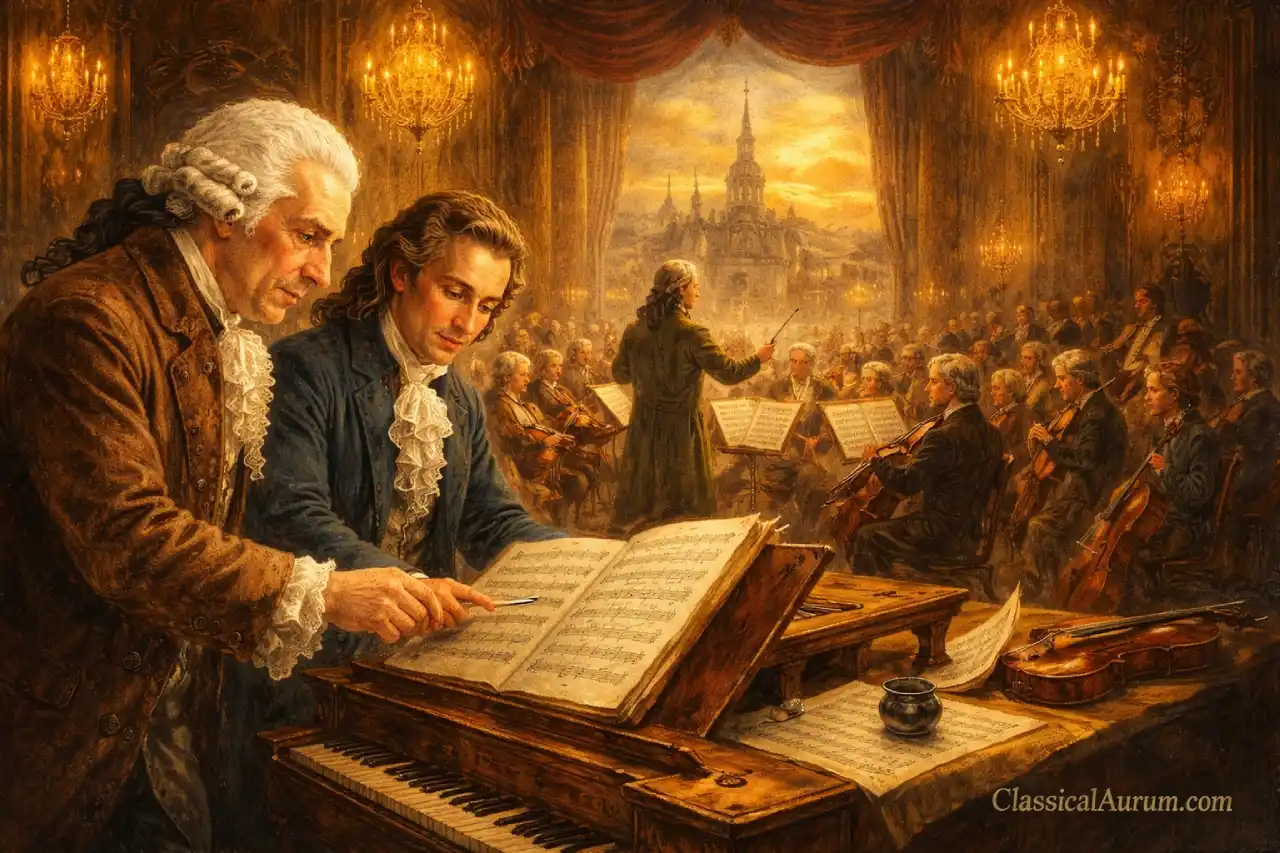
Haydn and Mozart admired each other deeply. Mozart dedicated six string quartets to Haydn. Haydn praised Mozart’s genius openly.
Their relationship was not rivalry but dialogue.
Mozart absorbed Haydn’s structural discipline. Haydn, in turn, recognized Mozart’s expressive daring.
This exchange enriched the symphony. Innovation became shared evolution rather than isolated achievement.
Together, they elevated instrumental music to philosophical stature. They prepared the ground for Beethoven, who would expand the symphony into heroic and monumental territory.
Without Haydn’s architecture and Mozart’s lyric drama, Beethoven’s symphonic revolution would have lacked foundation.
Toward Beethoven: The Legacy of the Classical Symphony
By the time Beethoven began composing symphonies, the genre was already mature.
Haydn established structure.
Mozart expanded emotional scope.
Beethoven intensified both.
The birth of the symphony, therefore, is not a single moment but a culmination of refinement during the Classical era.
Haydn and Mozart gave the symphony:
-
Formal stability
-
Thematic development
-
Orchestral balance
-
Emotional sophistication
-
Public prestige
Their work transformed instrumental music into a medium capable of expressing the deepest human experience.
Why the Birth of the Symphony Still Matters
At Classical Aurum, we view the symphony as more than historical repertoire. It represents a turning point in artistic thought.
The symphony embodies:
-
Intellectual architecture
-
Emotional narrative without words
-
Collective musical dialogue
-
Enlightenment balance between reason and expression
Modern orchestras still perform Haydn and Mozart not as museum pieces, but as living works.
Their symphonies teach listening discipline, structural awareness, and aesthetic proportion.
In an age saturated with fragmented sound, returning to the Classical symphony restores perspective.
It reminds us that music can unfold as argument, journey, and revelation.
The birth of the symphony is the birth of instrumental music as philosophical art.
And that legacy continues to resonate across centuries.