
Chamber Music Through History
The Origins of Chamber Music in European Culture
Chamber music occupies a unique place within the history of classical music. Unlike grand symphonic works written for large concert halls, chamber music was created for intimate spaces, private residences, aristocratic salons, and royal courts. The very term “chamber” refers to a room rather than a theater, emphasizing closeness between performers and listeners.
Its origins can be traced back to the late Renaissance and early Baroque periods. During the sixteenth and seventeenth centuries, music became increasingly important in European noble life. Wealthy families maintained private ensembles, and composers wrote smaller works specifically for indoor gatherings.
In Italy, Germany, Austria, and France, chamber music evolved alongside advances in instrumental craftsmanship. Violins, violas, cellos, harpsichords, and lutes became more refined and expressive. These developments allowed composers to create intricate musical conversations between instruments.
One of the defining features of chamber music is equality among performers. Unlike orchestral music, where sections may double lines, chamber works often assign independent musical ideas to every instrument. This creates a dialogue rather than a hierarchy.
Related: Why Chamber Music Still Matters
The Baroque era saw the rise of the trio sonata, a foundational form of chamber music. Composers such as Arcangelo Corelli and Antonio Vivaldi helped establish this genre across Europe. A typical trio sonata included two melodic instruments supported by basso continuo, usually performed by cello and harpsichord.
As chamber music spread, it became a symbol of intellectual refinement. Musical gatherings represented education, taste, and cultural prestige. Many aristocrats played instruments themselves, transforming music into both entertainment and social ritual.
Related: String Quartets Explained
Today, institutions such as Juilliard School and Royal Academy of Music continue to preserve this centuries-old tradition while introducing chamber repertoire to new generations.
Baroque Chamber Music and the Rise of Instrumental Dialogue
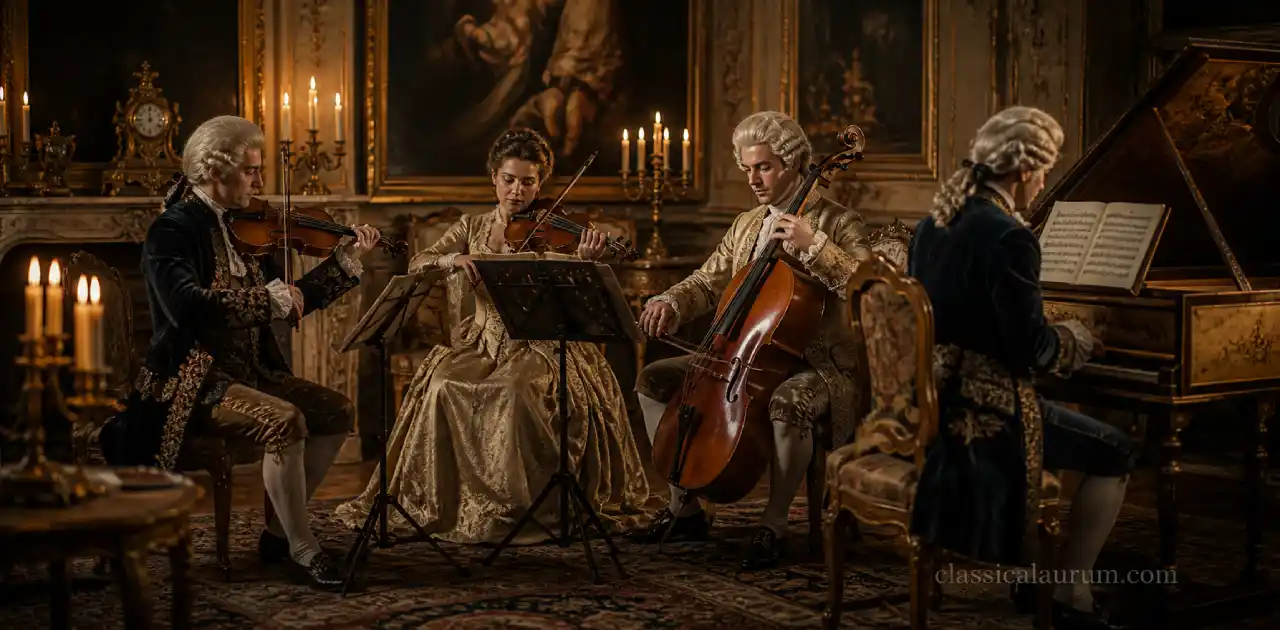
The Baroque period transformed chamber music into a sophisticated artistic form. Between approximately 1600 and 1750, composers explored contrast, ornamentation, and emotional intensity with unprecedented creativity.
Italy became the center of this evolution. Arcangelo Corelli is often considered one of the fathers of chamber music. His trio sonatas established structural clarity and expressive balance that influenced generations of composers. Through elegant melodic lines and harmonic organization, Corelli helped standardize instrumental writing.
Another important figure was Antonio Vivaldi, whose chamber works displayed rhythmic vitality and technical brilliance. Although famous for orchestral concertos such as The Four Seasons, Vivaldi also contributed significantly to smaller ensemble repertoire.
Johann Sebastian Bach expanded chamber music into a more intellectually complex form. His sonatas and partitas for solo violin and cello revealed how a single instrument could suggest multiple voices simultaneously. Bach’s musical architecture demonstrated profound mastery of counterpoint and harmony.
George Frideric Handel
George Frideric Handel contributed chamber sonatas and instrumental suites that blended Italian lyricism with German structural discipline. His music reflected the cosmopolitan character of eighteenth-century Europe.
The Baroque era also witnessed advances in instrument making. The violins crafted by Antonio Stradivari and Giuseppe Guarneri became legendary for their tonal beauty. These instruments enhanced expressive possibilities and shaped the future sound of chamber ensembles.
Performance settings remained intimate. Chamber music was often heard in candlelit salons, royal residences, and private gatherings rather than public concert halls. The close proximity between performers and audiences created a highly personal listening experience.
One defining characteristic of Baroque chamber music was improvisation. Ornamentation, continuo realization, and interpretive freedom allowed performers to participate creatively in the music itself. This collaborative spirit remains central to historically informed performance today.
Modern ensembles such as Academy of Ancient Music and Les Arts Florissants continue to revive Baroque chamber repertoire using period instruments and historical techniques.
The Classical Era and the Birth of the String Quartet
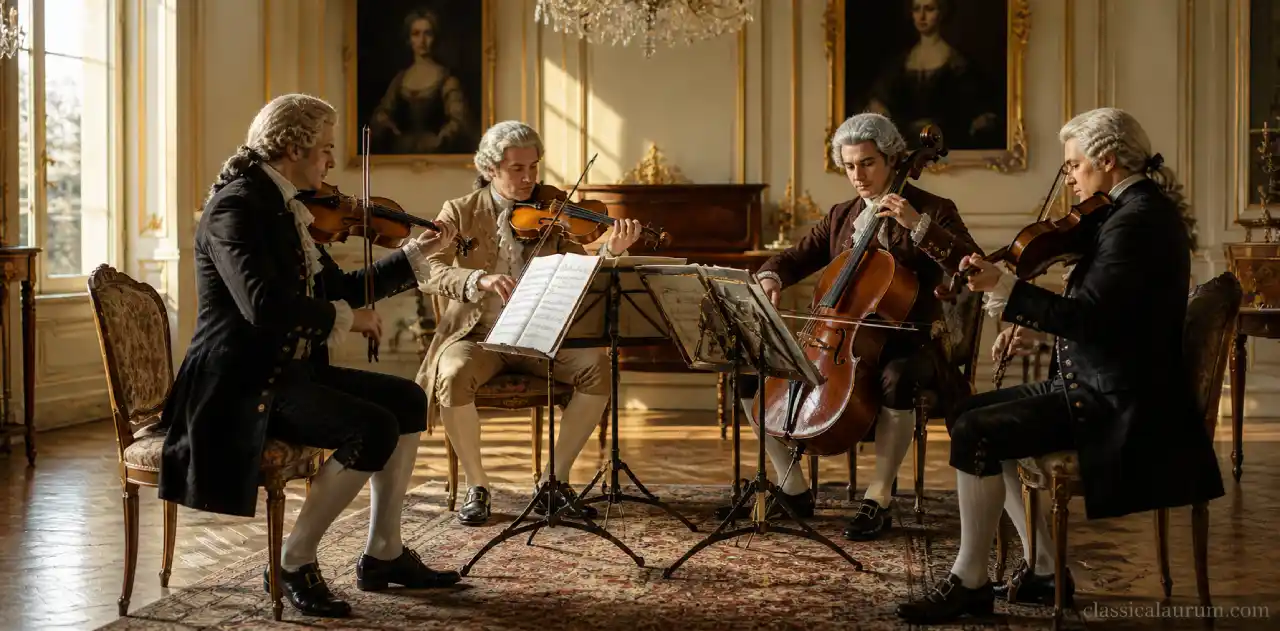
The Classical era elevated chamber music to extraordinary artistic heights. Between roughly 1750 and 1820, composers sought clarity, balance, and formal perfection. During this period, the string quartet emerged as the defining chamber music genre.
Joseph Haydn played the central role in this transformation. Often called the “Father of the String Quartet,” Haydn composed more than sixty quartets that established the genre’s structure and expressive possibilities. His works emphasized conversational interplay between instruments rather than simple accompaniment.
A standard string quartet consists of two violins, viola, and cello. This combination creates remarkable balance across registers and timbres. Each instrument contributes distinct musical ideas while remaining integrated within the ensemble.
Wolfgang Amadeus Mozart refined the quartet tradition even further. Inspired by Haydn’s innovations, Mozart composed quartets of exceptional elegance and emotional depth. His chamber works combined technical sophistication with lyrical beauty.
Ludwig van Beethoven revolutionized chamber music by expanding its emotional and philosophical scope. His early quartets followed Classical traditions, but his middle and late quartets pushed the boundaries of harmony, structure, and expression.
Beethoven’s late quartets remain among the most profound achievements in Western music. These compositions explore introspection, transcendence, and spiritual intensity in ways that continue to challenge performers and audiences alike.
The Classical era also saw the development of other chamber forms, including piano trios, piano sonatas, wind quintets, and string quintets. Music increasingly moved from aristocratic courts into public concert culture, making chamber repertoire accessible to broader audiences.
Vienna became the epicenter of this musical world. The city fostered an environment where composers, patrons, performers, and publishers interacted closely. Chamber music flourished as part of everyday cultural life.
Today, ensembles such as the Takács Quartet and the Emerson String Quartet continue to interpret Classical chamber repertoire for international audiences.
Romantic Chamber Music and Emotional Expression
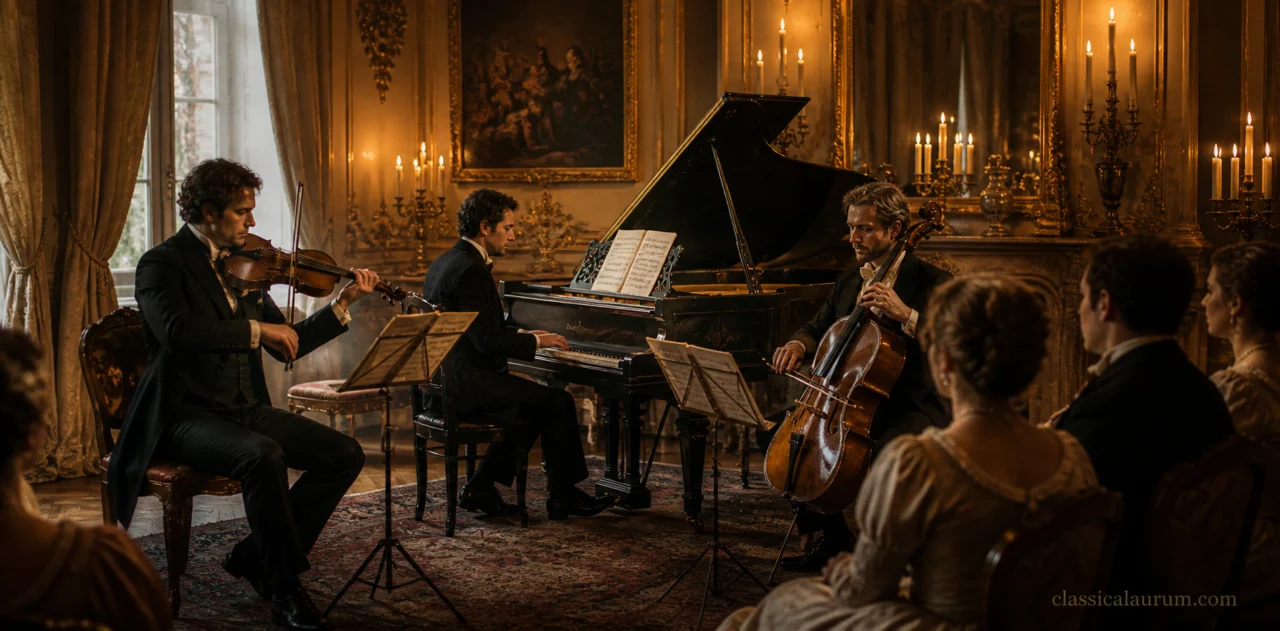
The Romantic era transformed chamber music into a deeply personal form of artistic expression. During the nineteenth century, composers increasingly emphasized individuality, emotional intensity, and poetic imagination.
Franz Schubert expanded the emotional range of chamber music through lyrical richness and harmonic innovation. Works such as the Trout Quintet and the Death and the Maiden Quartet combined intimacy with dramatic power.
Felix Mendelssohn brought elegance and structural clarity to Romantic chamber music. His octets and piano trios remain among the most beloved works in the repertoire. Mendelssohn balanced Classical discipline with Romantic warmth.
Robert Schumann infused chamber music with literary imagination and psychological complexity. His piano quintet became one of the defining masterpieces of the Romantic era, combining virtuosic piano writing with rich ensemble textures.
Johannes Brahms created chamber works of remarkable depth and architectural mastery. His string sextets, clarinet quintet, and piano quartets demonstrate emotional restraint combined with profound intensity.
The Romantic era also expanded the role of the piano within chamber ensembles. Improvements in piano construction allowed for greater dynamic range and expressive possibilities. As a result, piano trios, quartets, and quintets became increasingly popular.
National identity emerged as another important influence. Composers incorporated folk melodies, dances, and regional traditions into chamber music. Antonín Dvořák and Bedřich Smetana drew inspiration from Czech musical heritage, while Edvard Grieg reflected Norwegian traditions.
Concert halls gradually replaced private salons as the primary venues for chamber music performance. Nevertheless, intimacy remained essential. Even in larger settings, chamber music retained its conversational and human character.
Many Romantic composers viewed chamber music as a space for experimentation and introspection. Unlike opera or symphonic music, chamber works allowed for subtle emotional nuance and personal reflection.
Organizations such as Chamber Music Society of Lincoln Center continue to celebrate Romantic chamber repertoire through concerts, education, and recordings.
Twentieth-Century Innovations and Modern Chamber Music
The twentieth century introduced radical changes to chamber music. Composers experimented with harmony, rhythm, timbre, and structure in ways that redefined the genre.
Claude Debussy and Maurice Ravel brought impressionistic colors into chamber writing. Their works emphasized atmosphere, texture, and tonal ambiguity rather than traditional forms.
Arnold Schoenberg and the Second Viennese School challenged conventional tonality through atonal and twelve-tone techniques. Chamber music became a laboratory for modernist experimentation.
Béla Bartók integrated folk traditions with advanced rhythmic complexity and extended instrumental techniques. His string quartets are considered landmarks of twentieth-century music.
Dmitri Shostakovich used chamber music as a medium for personal and political expression. His quartets often contain hidden autobiographical messages and emotional tension reflecting Soviet life.
American composers also contributed significantly. Samuel Barber, Elliott Carter, and John Adams developed distinct chamber styles that blended modernism with national identity.
Twentieth-century chamber music expanded instrumentation dramatically. Ensembles began incorporating percussion, electronic sounds, and unconventional combinations of instruments. This broadened the expressive possibilities of the genre.
Contemporary chamber music frequently crosses artistic boundaries. Collaborations with dance, visual arts, film, and digital media have created immersive concert experiences for modern audiences.
Festivals dedicated to chamber music now exist worldwide. Events such as the Marlboro Music Festival and the Verbier Festival attract leading performers and emerging artists from across the globe.
Streaming platforms and digital recordings have also transformed accessibility. Listeners can now explore centuries of chamber repertoire instantly, discovering both historical masterpieces and contemporary works.
The Instruments That Defined Chamber Music
The evolution of chamber music is inseparable from the development of musical instruments. Certain instruments became central to the genre because of their expressive flexibility and tonal compatibility.
The violin family forms the foundation of most chamber ensembles. Violins, violas, and cellos create a balanced spectrum of sound capable of lyricism, virtuosity, and emotional depth.
The piano emerged as another dominant instrument during the Classical and Romantic eras. Its ability to produce harmony and melody simultaneously made it ideal for collaborative music making.
Woodwind instruments also gained prominence. Clarinets, flutes, oboes, and bassoons introduced new tonal colors into chamber repertoire. Mozart’s Clarinet Quintet remains one of the most celebrated examples.
Brass instruments appeared less frequently in traditional chamber settings but became increasingly important in twentieth-century repertoire. Horn trios and brass quintets expanded the sonic landscape of chamber music.
Guitar chamber music developed more gradually. Composers such as Luigi Boccherini and Mauro Giuliani explored combinations involving guitar and strings. In the modern era, classical guitar ensembles have gained broader recognition.
Instrument craftsmanship played a decisive role in shaping musical possibilities. Advances in bow design, string materials, and keyboard mechanisms enhanced technical capabilities and expressive range.
Historically informed performance has revived interest in period instruments. Many musicians now perform Baroque and Classical chamber works using historical techniques to recreate original sound worlds.
Museums and cultural institutions such as Metropolitan Museum of Art preserve rare instruments that illuminate the history of chamber music and craftsmanship.
Why Chamber Music Still Matters Today
Despite centuries of musical evolution, chamber music remains remarkably relevant in the modern world. Its enduring appeal lies in intimacy, communication, and human connection.
Unlike large orchestral performances, chamber music allows listeners to hear individual musical voices clearly. Every gesture, phrase, and interaction becomes part of an audible conversation.
For performers, chamber music demands exceptional listening skills and collaboration. Musicians must balance technical precision with collective sensitivity. This creates a unique artistic environment based on trust and communication.
Educational institutions frequently use chamber ensembles to train young musicians. Performing in small groups develops discipline, leadership, and interpretive awareness.
Audiences continue to value the emotional immediacy of chamber music. Even in large concert halls, the genre preserves a sense of closeness rarely found in other musical forms.
Modern composers still embrace chamber music because of its flexibility. Smaller ensembles allow for experimentation without the logistical demands of orchestral production.
Digital technology has also helped chamber music reach wider audiences. Online concerts, streaming services, and social media platforms enable ensembles to connect globally while maintaining artistic intimacy.
At Classical Aurum, chamber music represents more than historical repertoire. It reflects the enduring dialogue between tradition and modern sensitivity. Through centuries of transformation, chamber music has remained a living art form capable of expressing the deepest dimensions of human experience.
From Renaissance courts to contemporary festivals, chamber music continues to reveal the beauty of musical conversation. Its history is not merely a story of changing styles. It is the story of how individuals communicate emotion, intellect, and humanity through sound.