










From Lute to Modern Guitar
The Lute: The Ancestral Voice of Strings
The journey from lute to modern guitar begins with one of the most influential instruments in music history: the lute. Prominent throughout the Middle Ages and Renaissance, the lute was the dominant plucked string instrument in Europe.
Its origins can be traced to the oud, brought to Europe through cultural exchanges between the Islamic world and Western societies. Over time, the lute developed its distinctive shape, with a rounded back, multiple courses of strings, and a delicately carved rosette.
The lute became central to both courtly and intellectual life. It was used for solo performance, accompaniment, and complex polyphonic music, making it one of the most versatile instruments of its time.
Composers such as John Dowland elevated the lute repertoire to remarkable artistic heights. His music demonstrated the expressive potential of plucked strings, influencing generations of musicians.
Related: Modernism in Classical Music
Despite its complexity, the lute laid the essential groundwork for future instruments. Its tuning systems, playing techniques, and musical roles directly contributed to the emergence of the guitar.
The Renaissance Transition: Simplicity and Accessibility
As music evolved during the Renaissance, there was a growing desire for instruments that were more accessible and practical than the lute. This led to the development of early guitars.
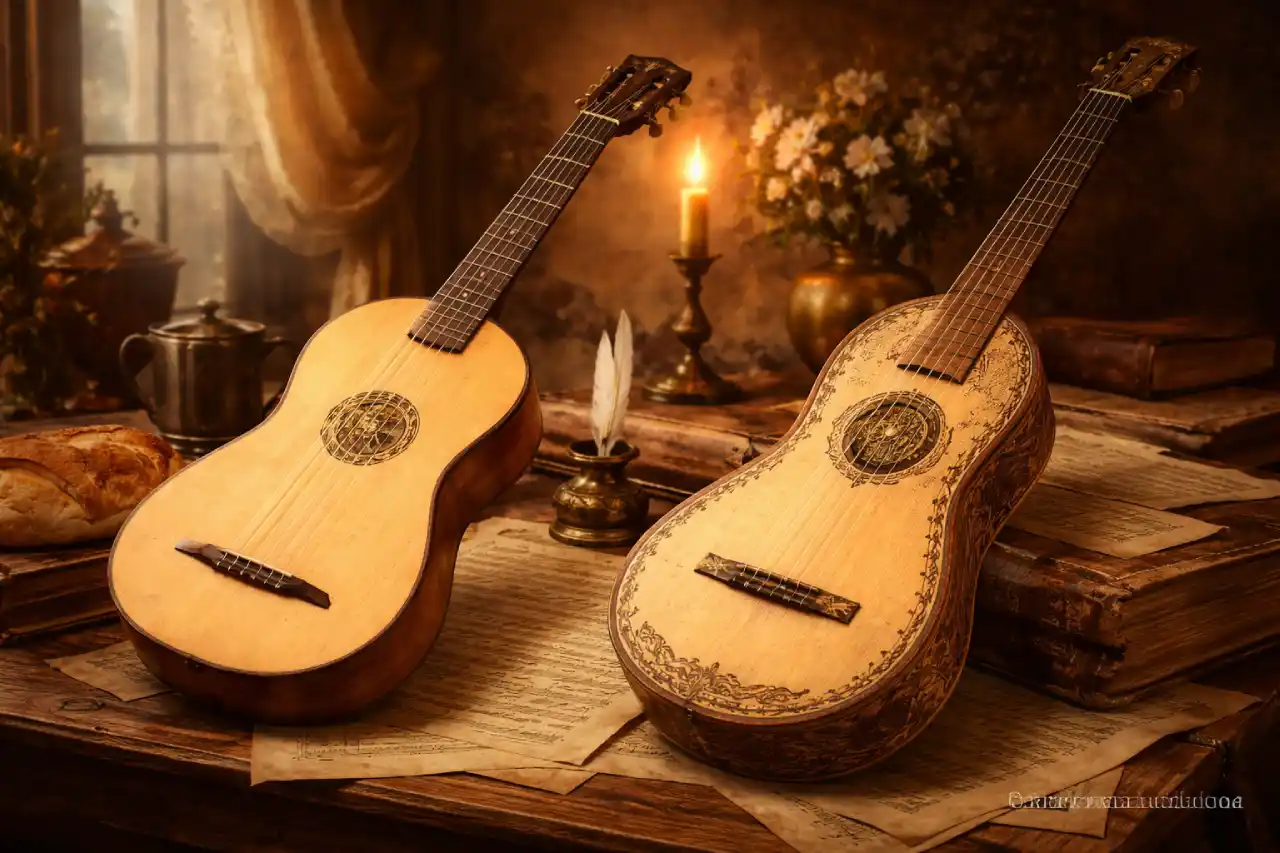
Unlike the lute, which required intricate tuning and technique, the Renaissance guitar featured fewer strings and a simpler structure. It was often used for strummed accompaniment, making it popular among a wider audience.
At the same time, the vihuela in Spain offered a more sophisticated alternative. With six courses and a tuning similar to the modern guitar, it bridged the gap between the lute and later guitar forms.
The coexistence of these instruments reflects a key moment in musical evolution. The Renaissance guitar introduced simplicity and portability, while the vihuela preserved the polyphonic tradition of the lute.
This period marked the beginning of the guitar’s identity as a distinct instrument, separate from its lute ancestry.
The Baroque Era: Ornamentation and Expansion
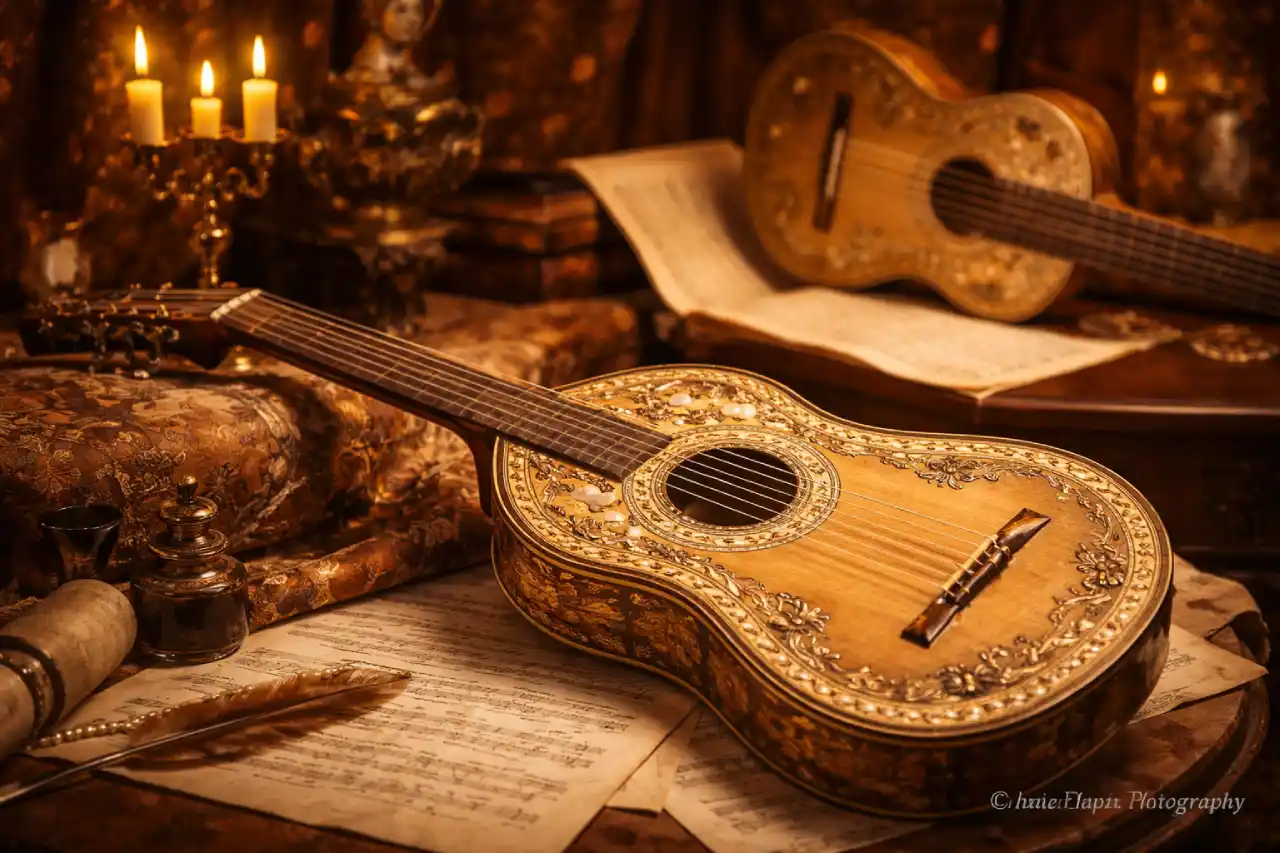
During the Baroque period, the guitar underwent significant transformation. The Baroque guitar became a fashionable instrument across Europe, particularly in France, Italy, and Spain.
With five courses of strings, it offered a richer harmonic palette than earlier guitars. Its design also became more elaborate, featuring decorative elements that reflected the artistic tastes of the time.
Musically, the Baroque guitar embraced both rhythmic strumming and intricate fingerstyle techniques. This dual approach allowed performers to create complex textures and expressive contrasts.
Composers such as Gaspar Sanz and Robert de Visée contributed to a growing repertoire that showcased the instrument’s versatility.
While the lute remained important, its dominance began to decline. The guitar’s simplicity, adaptability, and expressive potential made it increasingly popular.
This shift marked a crucial step in the transition from lute to guitar.
The Classical Era: Structural Transformation
The late 18th century brought profound changes to the guitar. During the Classical era, the instrument evolved into a more refined and standardized form.
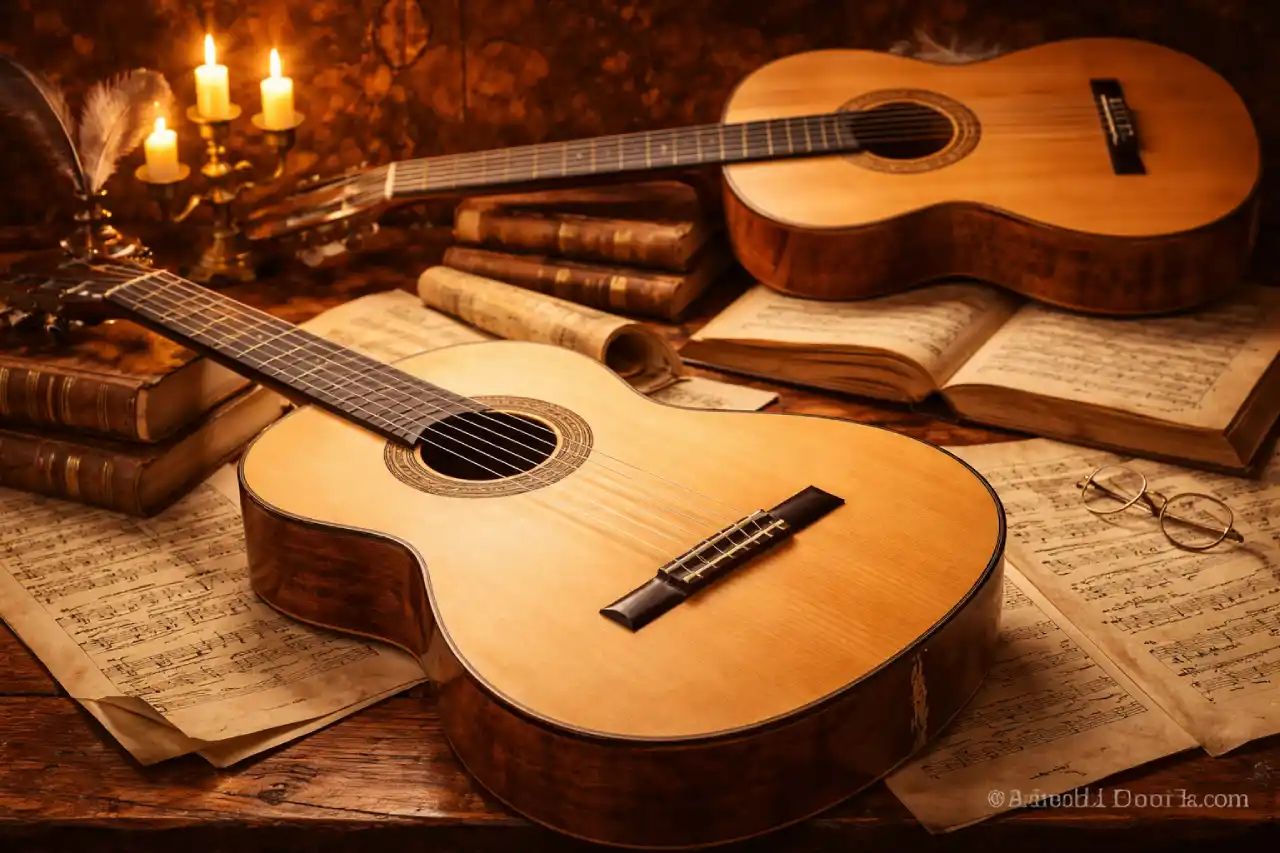
One of the most important developments was the transition from double courses to single strings. This innovation improved clarity and allowed for greater control over dynamics and articulation.
The guitar also adopted a six-string configuration, which remains standard today. This change expanded its range and made it more suitable for complex compositions.
Composers such as Fernando Sor and Mauro Giuliani played a key role in establishing the guitar as a legitimate classical instrument. Their works demonstrated its capacity for formal structure and expressive nuance.
At the same time, instrument makers began to experiment with design improvements, setting the stage for the modern classical guitar.
Antonio de Torres and the Birth of the Modern Guitar
No discussion of the evolution from lute to modern guitar is complete without highlighting Antonio de Torres Jurado. His contributions in the 19th century defined the modern classical guitar.
Torres redesigned the guitar’s body, making it larger and more resonant. He also developed the fan bracing system, which significantly improved sound projection and tonal balance.
These innovations transformed the guitar into a powerful concert instrument. The increased volume allowed it to compete with other instruments in larger performance spaces.
Torres’ designs became the blueprint for modern guitar construction. Even today, most classical guitars follow his principles.
His work represents the culmination of centuries of experimentation, bridging the gap between historical instruments and modern performance demands.
The Romantic Guitar: Expression and Intimacy
In the Romantic era, the guitar became an instrument of intimate expression. While it did not dominate large concert halls, it found a unique voice in smaller, more personal settings.
Composers such as Francisco Tárrega expanded the instrument’s expressive capabilities. His works emphasized tone color, phrasing, and emotional depth.
The guitar’s ability to produce subtle dynamics made it ideal for Romantic aesthetics. It could convey delicate emotions with a level of intimacy unmatched by many other instruments.
This period also saw an increase in transcriptions, bringing works from composers like Chopin and Beethoven into the guitar repertoire.
The Romantic guitar reinforced the idea that the instrument was not just a descendant of the lute—it was a fully developed artistic voice.
The 20th Century: Global Recognition and Expansion
20th century marked a turning point in the guitar’s history. Thanks to figures like Andrés Segovia, the classical guitar gained international recognition.
Segovia elevated the instrument to the concert stage, performing in major venues worldwide. He also expanded the repertoire by collaborating with contemporary composers.
Works by Heitor Villa-Lobos and Joaquín Rodrigo brought new depth and diversity to guitar music. These compositions combined traditional techniques with modern influences.
Technological advancements in instrument construction further improved sound quality and consistency. The guitar became more accessible to students and performers around the world.
This era solidified the guitar’s place within the classical music tradition.
The Modern Guitar: Tradition Meets Innovation
Today, the modern classical guitar represents a balance between tradition and innovation. While it retains the design principles established by Torres, it continues to evolve.
Modern luthiers experiment with materials such as carbon fiber and lattice bracing, enhancing projection and durability. These innovations expand the instrument’s capabilities without losing its characteristic sound.
Contemporary guitarists explore new genres and techniques, blending classical traditions with influences from flamenco, jazz, and global music.
Digital platforms have also transformed how music is shared and experienced. The guitar’s versatility makes it particularly well-suited to this new landscape.
Despite these changes, the instrument remains deeply connected to its historical roots.
A Continuous Evolution
The journey from lute to modern guitar is not a simple linear progression but a rich and complex evolution. Each stage contributed essential elements to the instrument we know today.
From the intricate polyphony of the lute to the expressive depth of the modern guitar, this evolution reflects broader changes in musical culture and artistic values.
The guitar’s enduring appeal lies in its ability to adapt while maintaining its identity. It is both a historical artifact and a living instrument.
For musicians and listeners alike, understanding this evolution deepens the appreciation of its sound and significance.