
How Orchestras Are Structured
The Foundation of the Orchestra: A System Built on Balance
An orchestra is not just a group of musicians.
It is a precisely structured system of sound, designed over centuries.
The modern orchestra evolved during the 18th and 19th centuries, shaped by composers like Ludwig van Beethoven and Wolfgang Amadeus Mozart.
Their works demanded greater coordination, expanded instrumentation, and clear hierarchy.
At its core, an orchestra is divided into families of instruments.
Each family contributes a distinct color, range, and emotional layer.
The structure exists for one purpose:
to create clarity within complexity.
Related: The String Family Explained
Without this organization, even the most brilliant composition would dissolve into chaos.
Every musician knows exactly where to sit, when to play, and how to blend.
This precision transforms individual sound into a unified musical experience.
Related: Sections of the Symphony Orchestra
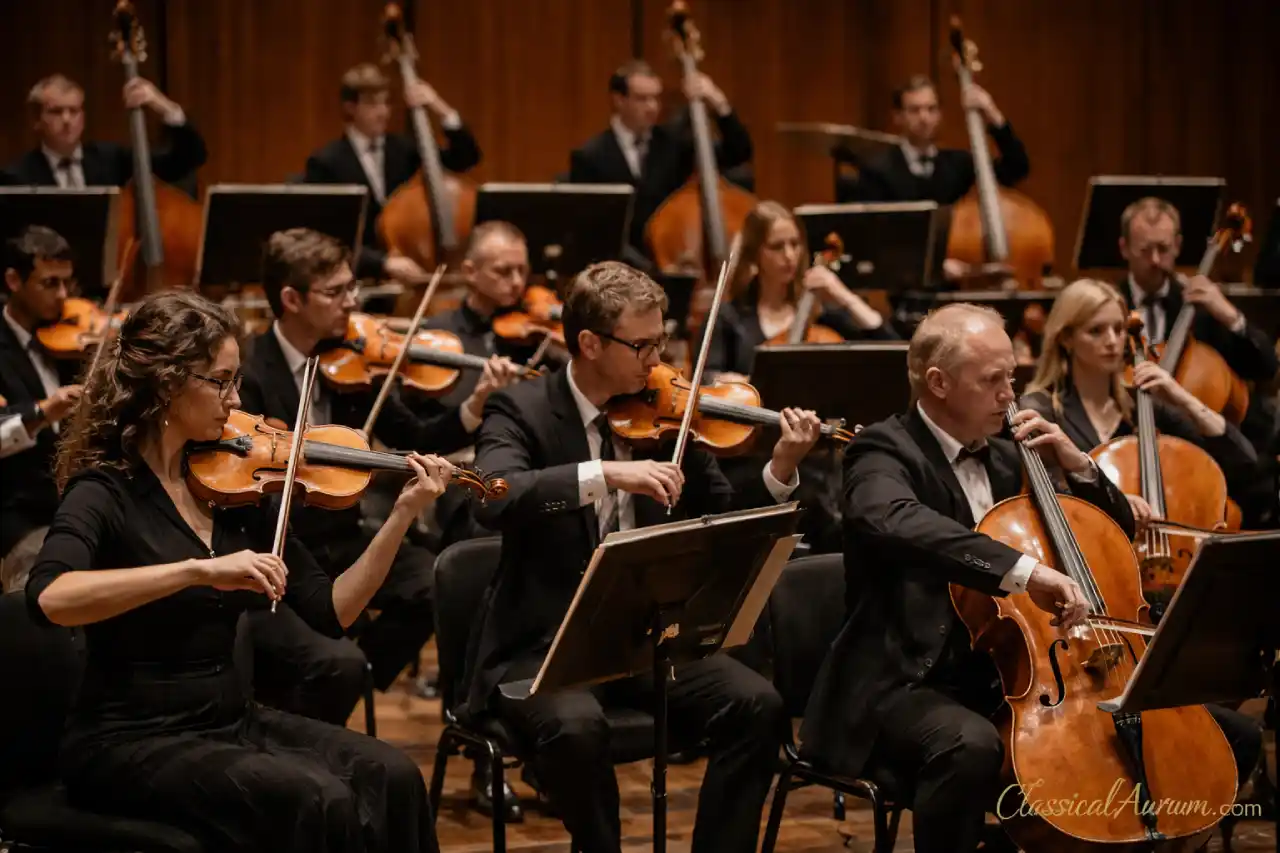
The String Section: The Core of the Orchestra
The string section is the heart of the orchestra.
It forms the largest group and provides the foundation of sound.
It includes:
- Violins (first and second)
- Violas
- Cellos
- Double basses
The first violins typically carry the melody.
They sit to the conductor’s left and lead the musical narrative.
The second violins support harmony and counter-melody.
They respond and interact with the first violins.
Violas fill the middle register, adding warmth.
Cellos provide depth and lyrical richness.
Double basses anchor the entire ensemble with low frequencies.
This section works like a living organism.
Every movement must be synchronized.
The concertmaster, the principal first violinist, acts as the bridge between conductor and musicians.
They tune the orchestra and lead by example.
In many works, the emotional weight of the piece rests entirely on the strings.
They shape tension, release, and atmosphere.
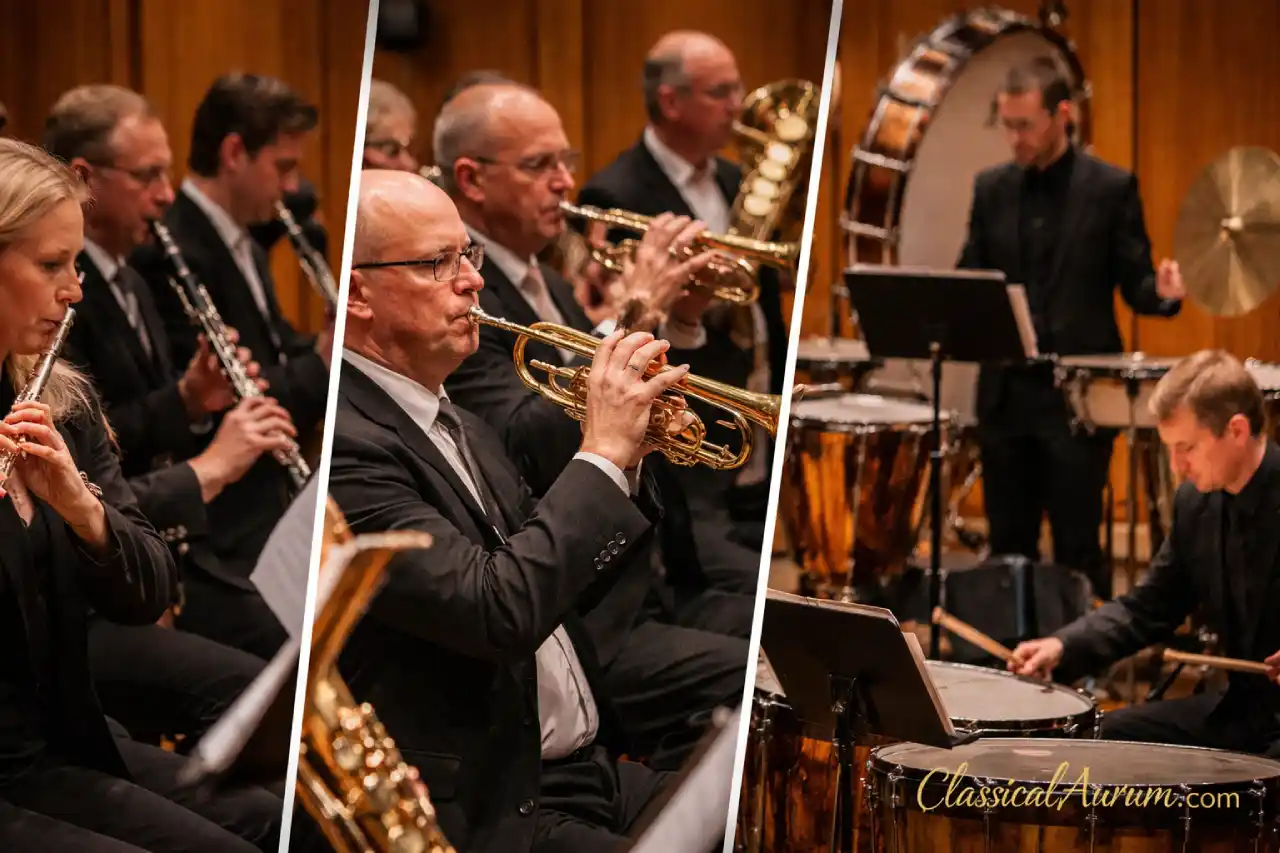
Woodwinds, Brass, and Percussion: Layers of Color and Power
Beyond the strings, orchestras rely on three additional sections.
Each adds unique character.
The woodwinds include:
- Flutes
- Oboes
- Clarinets
- Bassoons
These instruments provide melody, contrast, and expressive nuance.
Their sound can be delicate or piercing.
The brass section introduces power and brilliance:
- Trumpets
- French horns
- Trombones
- Tubas
Brass instruments are often used for dramatic climaxes.
They symbolize strength, tension, or triumph.
The percussion section adds rhythm and texture:
- Timpani
- Snare drum
- Cymbals
- Mallet instruments
Percussion defines timing and impact.
A single strike can transform the entire emotional direction of a piece.
Together, these sections create a multi-dimensional soundscape.
Each layer must be carefully balanced.
Too much brass overwhelms.
Too little percussion weakens momentum.
Structure ensures equilibrium.
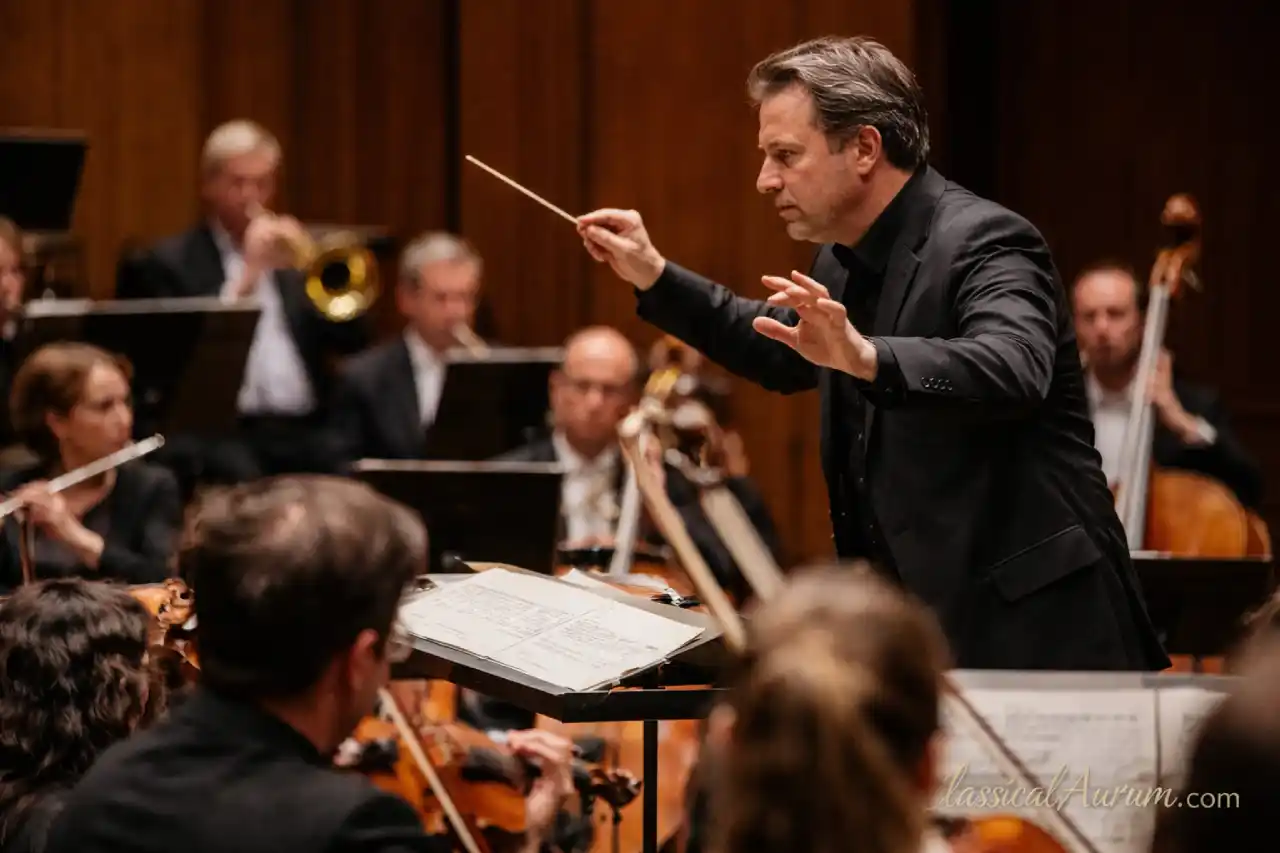
The Role of the Conductor and Leadership Hierarchy
At the center of the orchestra stands the conductor.
They are not simply a timekeeper.
They are the architect of interpretation.
The conductor controls:
- Tempo
- Dynamics
- Expression
- Coordination
Using gestures, they communicate subtle instructions.
A small movement can reshape the sound of 80 musicians.
Famous conductors like Herbert von Karajan and Leonard Bernstein transformed orchestral performance into an art form of leadership.
However, the conductor is not alone.
Each section has a principal player:
- Principal violin
- Principal oboe
- Principal trumpet
These musicians guide their sections.
They ensure internal cohesion.
The hierarchy is essential.
Without leadership at multiple levels, coordination would collapse.
This structure mirrors complex systems in nature.
Central direction combined with distributed responsibility.
Seating Arrangement and Spatial Design of Sound
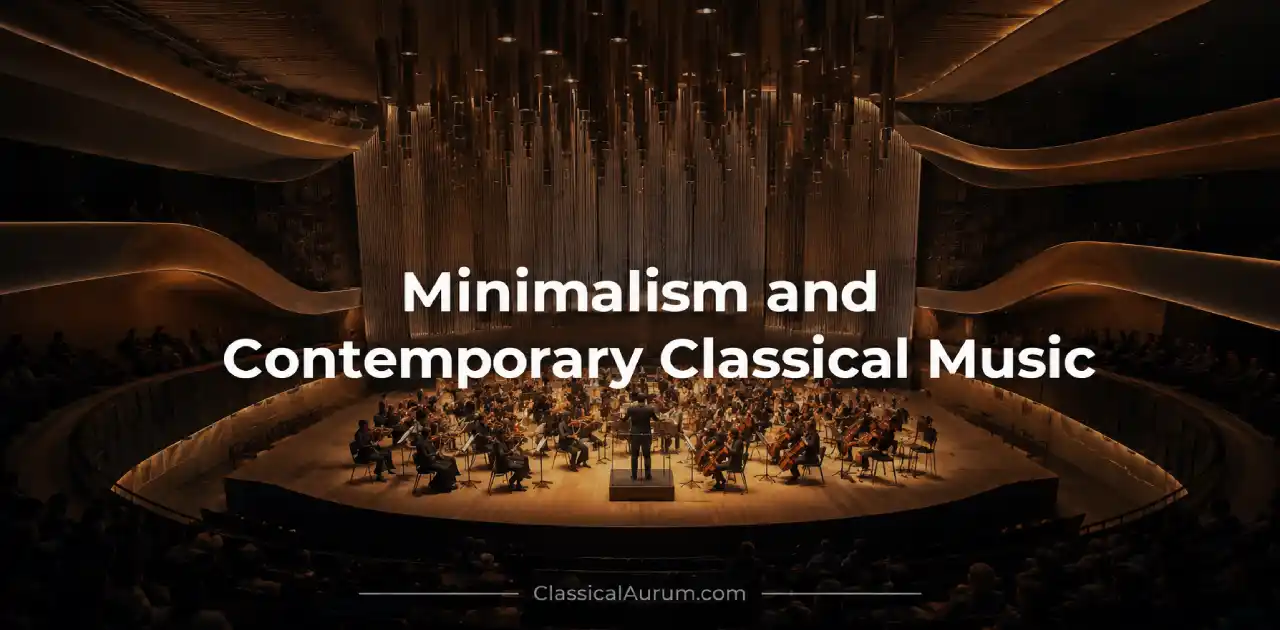
Orchestra seating is not random.
It is carefully designed to optimize acoustic balance.
A typical layout places:
- Strings at the front
- Woodwinds in the center
- Brass behind them
- Percussion at the back
This arrangement allows sound to travel naturally.
Violins project forward.
Brass resonates over the ensemble.
Percussion delivers impact from behind.
Different orchestras may adjust layouts.
Some conductors prefer alternative violin placements.
These changes influence how audiences perceive the music.
Even small variations can alter:
- Clarity
- Blend
- Direction of sound
The stage becomes an acoustic architecture.
Every position matters.
Types of Orchestras: From Chamber to Symphony
Not all orchestras are the same.
Structure changes depending on size and repertoire.
A chamber orchestra is small.
It may include 20–40 musicians.
This format emphasizes clarity and intimacy.
A symphony orchestra is much larger.
It can exceed 80 musicians.
This allows for massive dynamic range and complexity.
There are also specialized ensembles:
- Baroque orchestras
- Modern contemporary ensembles
- Film orchestras
Each type adapts structure to its musical needs.
For example, Baroque orchestras often use fewer players and historically informed instruments.
Modern orchestras may expand percussion or include electronic elements.
Structure evolves with music.
Why Structure Matters: The Science Behind Orchestral Unity
The structure of an orchestra is not only artistic.
It is also scientific.
Sound waves interact in complex ways.
Frequency, timing, and positioning all influence perception.
When musicians play together, they must align precisely.
Even slight deviations create acoustic interference.
The orchestral structure minimizes these risks.
It ensures:
- Timing precision
- Balanced frequencies
- Controlled dynamics
This is why rehearsals focus heavily on coordination.
An orchestra is one of the most complex human systems.
It requires discipline, listening, and awareness.
The result is something extraordinary.
A unified sound created by dozens of individuals.
The Evolution of Orchestral Structure in the Modern Era
Orchestras continue to evolve.
Contemporary composers push boundaries.
They experiment with new instruments and spatial arrangements.
Technology is also changing performance.
Some orchestras incorporate:
- Digital sound design
- Amplification
- Visual elements
Yet the core structure remains intact.
Strings still lead.
Sections still balance each other.
This continuity reflects the enduring efficiency of the orchestral model.
Even in modern contexts, the traditional structure proves adaptable.
Conclusion: A Living Architecture of Sound
An orchestra is more than a musical group.
It is a living architecture of sound.
Every section has a purpose.
Every musician has a role.
Structure transforms complexity into harmony.
From the strings to the conductor, each element contributes to a unified whole.
Understanding how orchestras are structured reveals something deeper.
It shows how order creates beauty.
And why, centuries later, the orchestra remains one of the most powerful forms of artistic expression.