







Fernando Sor and the Guitar Repertoire
The evolution of the classical guitar repertoire cannot be understood without the profound influence of Fernando Sor, a composer whose work helped elevate the guitar from a popular instrument to a respected voice within classical music. Known as the “Beethoven of the guitar,” Sor’s legacy continues to shape how guitarists approach technique, interpretation, and musical expression. His compositions represent a bridge between the Classical and early Romantic periods, offering a refined musical language that remains central to the identity of the instrument.
The historical context of Fernando Sor’s work
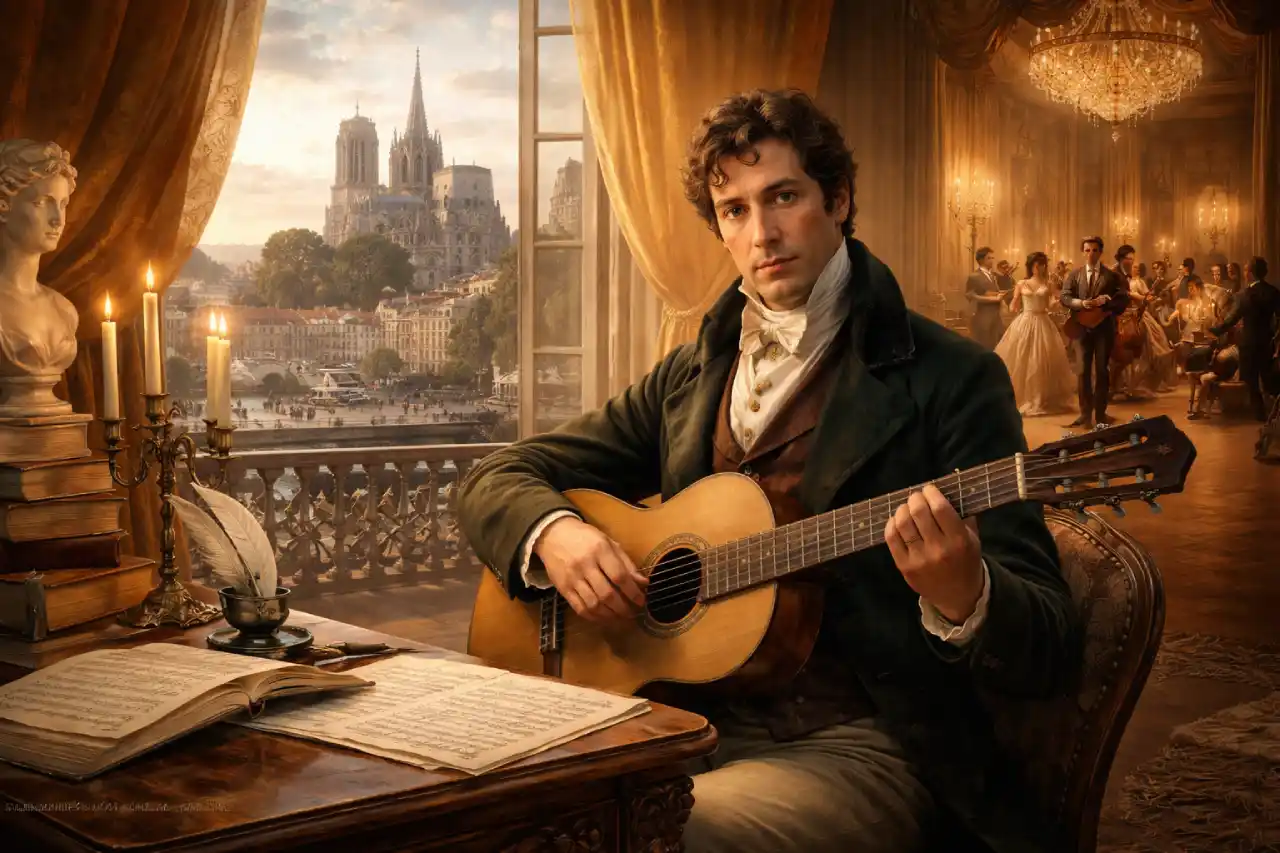
Born in Barcelona in 1778, Fernando Sor grew up during a time of intense cultural and political transformation in Europe. The late Classical era was marked by the dominance of composers like Haydn and Mozart, whose influence extended far beyond orchestral and chamber music. Sor absorbed this aesthetic deeply, integrating its clarity, balance, and formal structure into his guitar compositions.
Unlike many guitarists of his time, Sor did not treat the instrument as a vehicle for virtuosic display alone. Instead, he approached it as a serious compositional medium, capable of expressing nuanced musical ideas. His early exposure to opera and symphonic music informed his understanding of harmony and counterpoint, which became defining features of his works.
Related: Why the Violin Leads the Orchestra
This historical positioning allowed Sor to craft a repertoire that aligned the guitar with mainstream European musical traditions, rather than isolating it as a folkloric or salon instrument.
Related: The History of the Classical Guitar

Sor’s contribution to the classical guitar repertoire
Sor’s output includes études, sonatas, variations, and concert works, all of which demonstrate a sophisticated understanding of the guitar’s possibilities. His Études, Op. 6 and Op. 35, remain foundational in guitar pedagogy, combining technical challenges with musical depth.
Related: The Violin and Its Central Role
One of Sor’s most significant contributions was his insistence on musical integrity over technical spectacle. His compositions emphasize voice leading, harmonic clarity, and structural coherence. This approach set a new standard for guitar writing, encouraging composers and performers to treat the instrument with the same seriousness as piano or violin.
Related: Romanticism in Classical Music
His works also expanded the guitar’s expressive range. Through careful use of dynamics, articulation, and phrasing, Sor demonstrated that the guitar could sustain long musical lines and complex textures, challenging the perception of its limitations.

The role of pedagogy in Sor’s legacy
Beyond composition, Sor made lasting contributions through his pedagogical writings. His method, often referred to as “Méthode pour la guitare,” is not merely a technical manual but a philosophical treatise on music-making.
Related: The Piano in Classical Music
In this work, Sor emphasizes the importance of tone production, finger independence, and musical phrasing. He advocates for a disciplined approach to practice, where technique serves musical expression rather than overshadowing it. His pedagogical principles continue to influence modern guitar education, forming the basis of many contemporary teaching methods.
Sor’s études exemplify this philosophy. Each piece addresses specific technical challenges while maintaining a strong musical identity, making them indispensable tools for developing both skill and artistry.
Related: The Classical Period Explained
Stylistic characteristics of Sor’s compositions
Sor’s music is characterized by its elegance, clarity, and structural balance. Drawing from Classical forms such as the sonata and theme-and-variations, his compositions exhibit a strong sense of proportion and coherence.
One of the defining features of his style is his use of counterpoint, which allows multiple voices to coexist within a single instrument. This technique gives his music a richness and depth that set it apart from more straightforward guitar writing.
Harmonically, Sor’s works reflect the transition from Classical to Romantic aesthetics. While rooted in traditional tonal structures, his music occasionally ventures into more expressive harmonic territory, hinting at the developments that would later define Romanticism.
Another important aspect is his economy of texture. Sor avoids unnecessary ornamentation, focusing instead on clarity and precision. This restraint enhances the expressive power of his music, allowing subtle nuances to emerge.
Sor’s influence on later composers and performers
The impact of Fernando Sor extends far beyond his own lifetime. His approach to composition and pedagogy laid the groundwork for future generations of guitarists and composers.
Figures such as Francisco Tárrega and Andrés Segovia drew inspiration from Sor’s works, incorporating his principles into their own playing and teaching. Through Segovia’s efforts in the 20th century, Sor’s music gained renewed prominence, becoming a cornerstone of the modern guitar repertoire.
Sor’s influence is also evident in the way contemporary composers write for the guitar. His emphasis on structural integrity and musical depth continues to shape compositional approaches, ensuring that the guitar remains a vital and respected instrument within classical music.
The enduring relevance of Sor’s études
Among Sor’s most enduring contributions are his études, which serve as both technical exercises and concert pieces. These works address a wide range of challenges, from right-hand arpeggios to left-hand coordination and position shifts.
What sets Sor’s études apart is their musical sophistication. Unlike purely mechanical exercises, they are fully realized compositions that engage the performer emotionally and intellectually. This dual function makes them invaluable for both students and professionals.
In the context of modern guitar education, Sor’s études continue to provide a foundation for developing technique and musicality. Their relevance has not diminished over time; instead, they have become even more essential as the repertoire has expanded.
Interpreting Sor in the modern era
Performing Sor’s music today requires a nuanced understanding of historical context and stylistic conventions. Guitarists must balance technical precision with expressive sensitivity, ensuring that the clarity and elegance of the music are preserved.
Interpretation involves careful attention to phrasing, dynamics, and articulation. Given the relative simplicity of the textures, even small variations in tone and timing can have a significant impact on the overall effect.
Modern performers also face the challenge of adapting Sor’s works to contemporary instruments, which differ in construction and sound from those of his time. This requires thoughtful consideration of technique and interpretation to maintain the authenticity of the music.
Fernando Sor and the identity of the classical guitar
Ultimately, Fernando Sor’s legacy is inseparable from the identity of the classical guitar itself. His work helped define what the instrument could achieve, both technically and musically.
By aligning the guitar with the broader traditions of Western classical music, Sor ensured its place within the concert repertoire. His compositions continue to be performed, studied, and admired, serving as a testament to his vision and artistry.
For ClassicalAurum.com, the exploration of Sor’s repertoire represents more than historical analysis. It is an invitation to engage with the foundations of the classical guitar, to understand its evolution, and to appreciate the artistry that continues to inspire musicians today.